


Makoko Crisis: Lagos announces $2m Redevelopment plan after Demolition backlash

 Quick Read
According to him, the $2 million earmarked for Makoko forms part of Lagos State’s commitment to improving living conditions, sanitation, infrastructure and social amenities in the fishing community through collaboration with development partners, including the United Nations.
By Kazeem Ugbodaga
The Lagos State Government has committed $2 million towards the redevelopment of Makoko, the waterfront fishing community that has been at the centre of intense public debate following recent demolition exercises in parts of the settlement.
Special Adviser to the Governor on eGIS, Olajide Babatunde, disclosed this on Monday during a press briefing at the Bagauda Kaltho Press Centre, Alausa, Ikeja.
He said the funding represents Lagos State’s counterpart contribution to ongoing redevelopment discussions involving international partners.
“We have been carrying out regeneration projects in Lagos since the beginning of this administration,” Babatunde said, adding that “Even before I joined government, from 2019 through 2023, regeneration initiatives were already underway, and from 2023 to date, we have continued and expanded those efforts without interruption.”
He explained that Makoko had become a focal point of public concern but insisted that the government’s approach must be understood within the broader framework of urban renewal, safety and environmental responsibility.
“Makoko is a fishing community. It is made up of the land part and also the water part. Much of the attention is on the water section, but before addressing Makoko directly, it is important to explain the thinking guiding this administration’s regeneration efforts.”
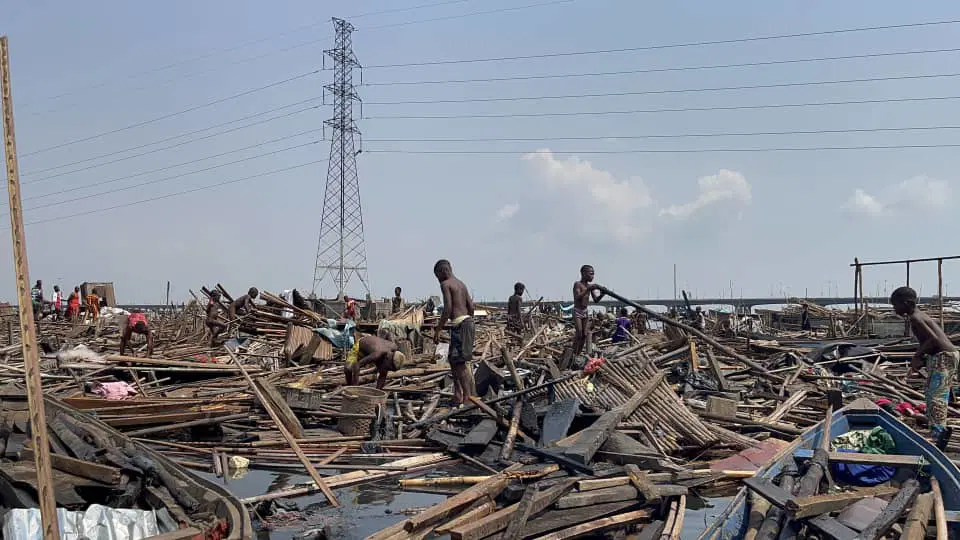
Makoko, one of Lagos’ most recognisable informal settlements, has drawn national and international attention in recent weeks following the demolition of several waterfront structures by state authorities.
The demolitions, which the government said were targeted at unsafe buildings and areas beneath high-tension power lines, sparked protests by residents and civil society groups who accused the state of forced evictions without adequate notice or resettlement.
Demonstrations by Makoko residents spilled onto major roads and government facilities, with protesters demanding an immediate halt to demolitions, compensation for displaced families and clearer redevelopment plans.
Human rights organisations and advocacy groups also raised concerns over the humanitarian impact of the exercise, warning that thousands risked being rendered homeless.
The uproar revived long-standing tensions surrounding Makoko, a community that has historically existed outside formal planning frameworks despite its economic importance as a fishing hub. Previous attempts to regulate or redevelop the area, dating back more than a decade, have often triggered resistance, court actions and international scrutiny.
Against this backdrop, the Lagos State Government has repeatedly insisted that the recent actions were driven by safety considerations rather than an agenda to clear the community.
Addressing the controversy directly, Babatunde said the government’s redevelopment plan for Makoko was neither sudden nor punitive.
“Let me reiterate: the government will not act arbitrarily. We will continue to engage communities, uphold safety standards, compensate where required, and implement regeneration plans that protect Lagos residents and create sustainable, well-planned environments,” he stated.
He stressed that the state prefers negotiation to enforcement, saying that “Our approach is bottom-up, not top-down,” Babatunde said. “We do not proceed without negotiation and stakeholder input.”
According to him, the $2 million earmarked for Makoko forms part of Lagos State’s commitment to improving living conditions, sanitation, infrastructure and social amenities in the fishing community through collaboration with development partners, including the United Nations.
“The Governor has committed $2 million to the redevelopment of Makoko,” he said, adding that “We were expecting counterpart funding from development partners, but we are also mindful of global funding constraints affecting donor agencies. That is why Lagos State is calling on donor agencies, businesses within and outside Nigeria and the international community to support targeted interventions.”
Babatunde linked Makoko’s redevelopment to similar regeneration efforts across the state, citing the relocation of sawmill operators from Okobaba as a model of engagement-driven intervention.
“That relocation was carried out peacefully and systematically. The former site experienced repeated fire outbreaks every few months. A responsible government cannot overlook such conditions.”
He said the same safety logic applies to Makoko.
“Regeneration is not punishment. It is not gentrification. It is not about removing the poor to replace them with the rich. It is about safeguarding lives and ensuring that every resident of Lagos lives in a safe and dignified environment,” he said.
He added that recent fire incidents in densely built-up areas of Lagos had underscored the need for stricter planning controls.
“Where uncontrolled development creates hazards, blocked access routes, lack of fire exits and unsafe setbacks, government must act,” he said.
Babatunde also clarified that earlier proposals to reclaim land through shoreline extension in Makoko had been abandoned.
“Shoreline extension was considered, but it was abandoned after technical and environmental assessments found it unsustainable.”
He said the Lagos State Executive Council subsequently approved the Water Cities model as the preferred alternative.
“The Water Cities model is the only environmentally responsible option. It ensures free water flow and long-term resilience. The proposed Water Cities project will be located within Makoko’s existing footprint,” he said, saying that “Any removals are limited strictly to high-tension corridors, and vertical development, rather than horizontal sprawl, is the preferred approach.”
Babatunde said engagement with Makoko residents has been ongoing, particularly around safety risks posed by high-tension power corridors.
“The clearing of high-tension corridors is a statewide safety policy. It is not unique to Makoko and forms part of a broader life-saving strategy,” he explained.
Comments