



Defiant Trump slaps 10% Global Tariff despite Supreme Court smackdown

 Quick Read
The president signed an executive order effective immediately, invoking Section 122 of the 1974 Trade Act, which permits temporary tariffs of up to 15% for a maximum of 150 days to address balance-of-payments issues, though extensions require congressional approval.
By Kazeem Ugbodaga
In a defiant response to a landmark Supreme Court decision striking down his sweeping global tariffs, President Donald Trump announced on Friday that he would immediately impose a 10% tariff on imports worldwide using alternative legal authority, vowing to protect American interests despite the judicial setback.
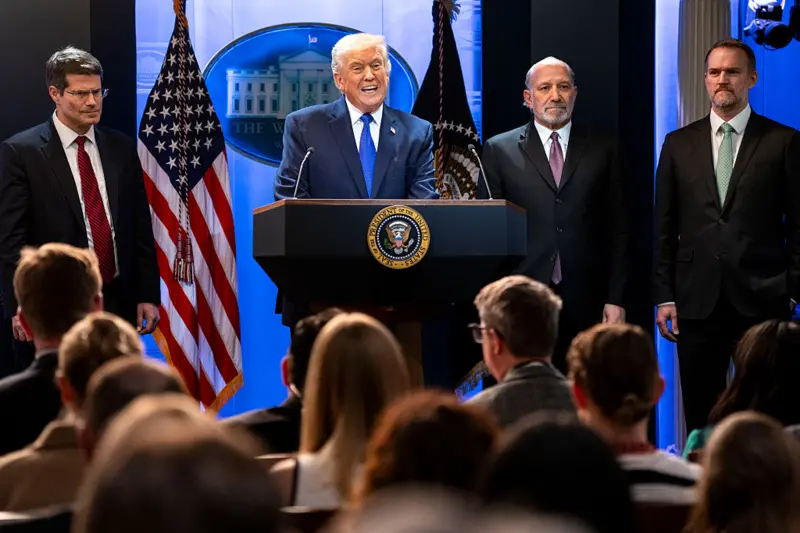
The move, declared during a White House press briefing flanked by Solicitor General D. John Sauer, Commerce Secretary Howard Lutnick, and Trade Representative Jamieson Greer, comes hours after the high court ruled 6-3 that Trump exceeded his powers under the International Emergency Economic Powers Act (IEEPA) when he enacted broad “reciprocal” tariffs and targeted duties aimed at curbing fentanyl trafficking.
The president signed an executive order effective immediately, invoking Section 122 of the 1974 Trade Act, which permits temporary tariffs of up to 15% for a maximum of 150 days to address balance-of-payments issues, though extensions require congressional approval.
“This is about protecting our country,” Trump stated, emphasizing that the Supreme Court’s ruling only limited the use of IEEPA and did not invalidate tariffs broadly.
He assured that previously imposed duties, including those under Section 232 of the Trade Expansion Act of 1962 for national security reasons and Section 301 for unfair trade practices, would remain “in full force.”
Trump also signaled plans to launch new investigations under Section 301 to target alleged unfair practices by foreign nations, potentially leading to additional tariffs.
During a lively question-and-answer session with reporters, Trump dismissed the need for congressional consultation on the new measures.
“No need to, it’s already approved,” he said, referring to the existing authorities under Sections 232 and 301.
When pressed on whether the U.S. would refund the estimated $175 billion in tariff revenue collected since he announced expansive duties last year, dubbed “Liberation Day” by the administration, Trump replied, “It wasn’t discussed. I guess it has to get litigated for the next few years. How crazy is that? We’ll end up in court for five years.”
The president expressed frustration with the court’s interpretation, highlighting what he saw as an absurdity in U.S. trade law.
“I’m allowed to destroy a country’s trade, but I can’t give them a little fee,” he quipped, noting that while he could impose full embargoes or cut off all business with a nation, the ruling barred minor fees under IEEPA.
He suggested the decision was influenced by interests intent on shielding foreign economies, adding during the briefing that the Dow Jones Industrial Average had recently surpassed 50,000, crediting his economic policies.
The Supreme Court’s opinion, authored by a conservative majority, argued that Trump’s use of IEEPA for broad tariffs did not constitute a true national emergency and overstepped executive bounds.
The tariffs in question represented about half of the total import duties levied since Trump’s return to office, affecting goods from nearly every country and raising costs for American consumers and businesses.
White House officials have indicated that while replacing the struck-down tariffs will be challenging, the administration views the ruling as clarifying stronger presidential powers under other statutes.
Comments