



Trump vows to open Strait of Hormuz ‘One way or the other’

 Quick Read
Trump specifically named five nations he hopes will contribute naval assets to the mission, writing that he expects China, France, Japan, South Korea and the United Kingdom to send warships to the key shipping channel so it can "no longer be a threat" from Iran.
By Kazeem Ugbodaga
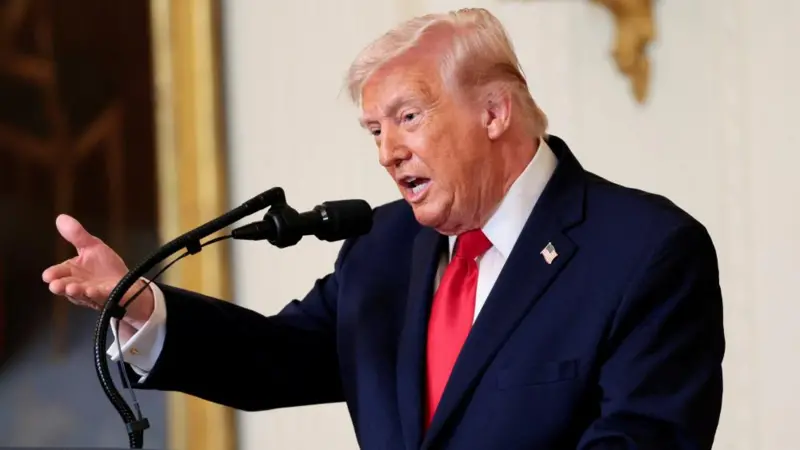
United States President Donald Trump has issued an ultimatum to Iran, declaring that the strategically vital Strait of Hormuz will be opened “one way or the other,” as he calls on allied nations to join a naval coalition to secure the waterway through which one-fifth of the world’s oil passes.
In a characteristically blunt post on his Truth Social platform, Trump wrote: “One way or the other, we will soon get the Hormuz Strait OPEN, SAFE, and FREE!” .
The statement comes amid escalating hostilities following major US strikes on Iran’s Kharg Island, the Islamic Republic’s primary oil export terminal and represents a significant expansion of Washington’s maritime strategy in the region.
Trump specifically named five nations he hopes will contribute naval assets to the mission, writing that he expects China, France, Japan, South Korea and the United Kingdom to send warships to the key shipping channel so it can “no longer be a threat” from Iran.
He added that many countries will ultimately join the effort to keep the strategic waterway “open and safe.”
The appeal reflects the global stakes involved. The Strait of Hormuz, a narrow passage between the Persian Gulf and the Gulf of Oman, normally carries approximately 20 percent of the world’s oil supplies, a flow that has been virtually halted since Iran effectively closed the waterway on March 1, following the launch of joint US-Israeli attacks.
In the meantime, Trump warned of continued and intensified military action against Iranian forces.
“The United States will be bombing the hell out of the shoreline, and continually shooting Iranian boats and ships out of the water,” he declared.
The president claimed that the US has “destroyed 100% of Iran’s military capability” but acknowledged that it remains “easy for them to send a drone or two, drop a mine, or deliver a close-range missile somewhere along, or in, this Waterway, no matter how badly defeated they are.”
Trump’s latest ultimatum follows the massive US strike on Kharg Island, which he described as “one of the most powerful bombing raids in the History of the Middle East” that “totally obliterated every MILITARY target in Iran’s crown jewel.”
Kharg Island, a small coral island approximately 30 kilometers off Iran’s coast, handles about 90 percent of Iran’s crude oil exports, loading roughly 1.7 million barrels per day before the conflict. Its deep-water terminal can accommodate up to 10 supertankers simultaneously, making it the linchpin of Iran’s energy economy.
In that same post, Trump noted that “for reasons of decency, I have chosen NOT to wipe out the Oil Infrastructure on the Island,” but attached a clear condition: “However, should Iran, or anyone else, do anything to interfere with the Free and Safe Passage of Ships through the Strait of Hormuz, I will immediately reconsider this decision.”
Saturday’s statement effectively activates that threat, signaling that continued disruption of shipping will invite strikes on Iran’s economic lifeline.
Iran’s representative in Geneva, Ali Bahrani, dismissed Trump’s claims about eliminating Tehran’s military capabilities as “based on fabricated lies.”
The Iranian military has issued stark warnings of its own. Following the Kharg Island strikes, Iran’s joint military command reiterated that it will attack US-linked oil and energy facilities in the region if the Islamic Republic’s oil infrastructure is hit.
Iranian Parliament Speaker Mohammad Bagher Qalibaf warned on Thursday that attacks on the islands on Iran’s southern maritime frontier would cause Iran to “abandon all restraint,” underscoring how central they are to the country’s economy and security .
Tehran has already retaliated for the Feb. 28 US-Israeli attacks, which have killed more than 1,200 people, including then-Supreme Leader Ayatollah Ali Khamenei, with drone and missile strikes targeting Israel, Jordan, Iraq, and Gulf countries hosting US military assets.
Comments