



Makoko and the politics of displacement in Lagos

 Quick Read
Makoko itself had become the immediate flashpoint, suffering yet another cycle of destruction
By Zikora Ibeh
One fact is now unmistakable. The Lagos State Government appears determined to empty Makoko of its inhabitants. But for the mass protest organised by the Coalition Against Demolition, Forced Evictions, Land Grabbing and Displacement on January 28, 2026, the historic riverine community might well have been erased with little public scrutiny and even fewer qualms.
That demonstration laid bare the depth of grievance simmering across Lagos. Nearly five thousand residents gathered in collective resistance, many of them survivors of forced evictions and illegal demolitions in Owode Onirin, Oworoshoki, Bariga, Ajegunle, Sogunro, and other communities.
Makoko itself had become the immediate flashpoint, suffering yet another cycle of destruction. In December 2025, armed demolition teams backed by state authorities entered the settlement under the pretext of enforcing a 30–100 metre safety corridor beneath a high-tension power line. That explanation quickly collapsed under the weight of the events that followed. The demolition squad pushed far beyond the stated boundary, uprooting thousands of residents and destroying homes and vital amenities such as schools.
The extraordinary brutality saw houses set ablaze with families still inside, while tear gas and live ammunition were discharged freely in the densely populated area. The assault left many injured and claimed several lives, including week-old infants exposed to tear gas and a pregnant woman who bled to death after being prevented from leaving the area during the exercise.
Confronted by mounting public outrage, the state eventually suspended the demolitions. But not before security forces under the command of the Lagos State Commissioner of Police, Jimoh Moshood, violently dispersed peaceful protesters gathered outside the Lagos State House of Assembly on January 28, firing teargas and leaving scores badly wounded.
Only after the backlash did the Lagos State House of Assembly, which had earlier ignored repeated pleas from residents and civil society groups to intervene, suddenly discover the urgency of action and constitute an ad hoc committee to examine the clearances and consider redress for affected communities.
Yet the manner in which the hearings proceeded raised concerns about whether the process was meant to deliver justice or legitimise a predetermined outcome.
From the outset, the inquiry kept civil society organisations and independent legal counsel at a distance. Impoverished residents, unaware of their right to broader representation, were left to face lawmakers largely alone. At one session, individuals who were not Makoko residents were asked to leave the room. Traumatised residents hesitated to insist on wider participation for fear of antagonising the very committee examining their plight.
This subtle pressure forced residents, already at their lowest, to engage the panel without advocates or proper legal representation. Responsibility, however, lies squarely with the lawmakers who organised the hearings. Fully aware of the imbalance, they embraced it. One can only conclude that the arrangement spared them the discomfort of public scrutiny and ensured the proceedings unfolded largely on their own terms.
The result is the recent resolution adopted by the Lagos State House of Assembly urging the state government to relocate residents of Makoko, Oko-Agbon and Sogunro communities to Agbowa in Epe.
A Dishonest Resolution
The first problem with the Assembly’s recommendation is its sheer dishonesty. Residents of Makoko never reached any agreement with the panel of inquiry to relocate outside their community. Presenting relocation to Epe as the logical solution merely disguises the Assembly’s endorsement of a state-driven displacement agenda.
Even where relocation is considered, international human rights standards provide clear guidelines. The United Nations frameworks on resettlement and internal displacement, which the Lagos State Government itself invokes through its claimed collaboration with the UN on a proposed Makoko redevelopment project, state that displacement must rest on compelling reasons, credible evidence, and a clear legal basis. Above all, it must involve genuine consultation and the informed consent of affected communities.
The African Commission on Human and Peoples’ Rights reinforces this position, holding that evictions carried out without consultation, compensation, and adequate resettlement violate the rights to housing, property, and human dignity.
Yet the Lagos State Government under Governor Babajide Sanwo-Olu has met none of these standards. Instead, its actions have drawn opprobrium and judicial rebuke, leading to court orders restraining the state, its agencies, and the Nigeria Police Force from further unlawful demolitions of waterfront communities.
Curiously, although the Assembly’s resolution acknowledges that living conditions in Makoko worsened after the demolitions, it says nothing about accountability for the deaths, injuries, displacement, and trauma inflicted on residents.
Clearing Land for Whom?
Viewed against Lagos’s own history, the relocation proposal raises a question. Forced clearances of working-class neighbourhoods have repeatedly preceded the capture of valuable urban land by elite and capitalist interests. Communities long neglected by government are routinely branded unsafe or environmentally problematic, then cleared in the name of urban renewal. In time, the same land resurfaces as the site of luxury estates for affluent buyers. In other cases, it lingers in speculative limbo as phantom projects that exist more in glossy brochures and investment prospectuses than in reality.
Events unfolding along the Makoko waterfront affirm this trend. Landfilling began along parts of the lagoon even as the state-backed demolitions were underway. Local accounts and media reports suggest that these activities are linked to a private real estate company known as FBT Coral, which has been associated with discussions about redeveloping the area. The implications are difficult to ignore.
Only weeks ago, the Lagos State Government, responding to outrage over its actions in Makoko, announced plans to transform the community into a modern “Water City” backed by partners from the United Nations. According to the state, the project is meant to improve housing and sanitation conditions and help more than two hundred thousand residents adapt to climate change.
Yet if relocation remains the state’s preferred solution, another question arises. Who exactly is the proposed Water City meant to serve?
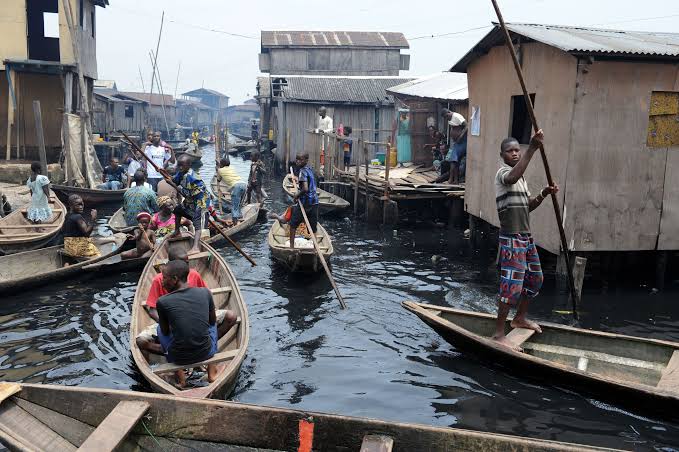
There is also a deeper climate hypocrisy embedded in the relocation argument. Lagos is a coastal city already confronting sea-level rise and intensifying flood risks. Around the world, planners increasingly study climate-resilient waterfront settlements and nature-based adaptation strategies. Makoko, particularly its stilt communities that extend into the lagoon, represents a remarkable example of such informal adaptation. Homes stand on stilts that have endured for years in the water. Mobility is water-based, and residents possess generations of practical knowledge about lagoon conditions.
Instead of studying how such communities live with water, Lagos continues to promote elite waterfront developments that reclaim land from fragile coastlines and reshape the lagoon environment. Ironically, these capital-intensive projects, which serve narrow class interests, pose far greater ecological risks than a fishing settlement ever could.
The Right to City for All
The House of Assembly may have passed a resolution calling for Makoko’s relocation, but the century-old community is not a settlement that can simply be uprooted and replanted elsewhere. It is a living lagoon community sustained for generations by fishing, canoe transport, petty trade, and market exchange closely tied to its location in Lagos.
Fisherfolk rely on deep knowledge of fishing grounds, tidal rhythms, and seasonal patterns. Canoe operators navigate routes that link the settlement to the city’s commercial arteries, while market women depend on nearby urban consumers who buy their daily catch. Uprooting the community would fracture this intricate ecological and economic system and sever connections that cannot easily be rebuilt elsewhere.
History shows that when communities are displaced from the places where their social systems are rooted, the consequences are rarely benign. The loss of economic ties, social networks, and cultural familiarity compounds over time, leaving communities poorer and more vulnerable.
The Makoko crisis also forces a more fundamental question about what citizenship means in a city like Lagos. Cities are not just arrangements of land, buildings, and infrastructure. They are spaces produced through the labour, culture, and survival of the people who inhabit them. This is the essence of the Right to the City, a principle that holds that urban space belongs to those who build it through their daily lives.
The Right to the City envisions cities and human settlements as common goods meant to benefit everyone. It rejects the notion that urban development should function as a transfer of the city from the many who build it to the few who can afford to hijack it. Yet this is precisely the road Lagos has consistently travelled.
Makoko offers Lagos a chance to rethink its urban future. Instead of riding roughshod over poor communities, the state should recognise them as part of the city’s social and ecological fabric. Any redevelopment must begin with the rights and participation of residents and with full accountability for years of neglect and the harms already inflicted.
Ibeh, a researcher and development advocate, is the Assistant Executive Director at Corporate Accountability and Public Participation Africa (CAPPA).
Comments