


Nigerian scientist’s technology helps power brain organoid robot breakthrough

 Quick Read
A groundbreaking experiment connecting human brain cells to a robotic system is drawing international attention and a Nigerian scientist played a key role in making it possible.
A groundbreaking experiment connecting human brain cells to a robotic system is drawing international attention and a Nigerian scientist played a key role in making it possible.
The research, published in Nature Communications in August 2025, demonstrated that human brain organoids, tiny brain-like tissues grown from stem cells, can process sensory information and guide the movements of a robotic system in real time.
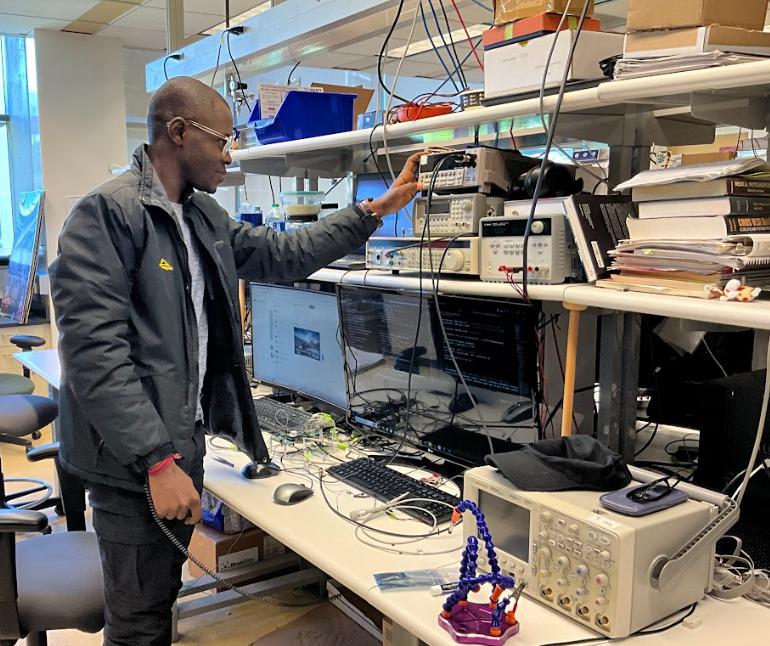
Central to the experiment was neural interface technology developed by Omowuyi O. Olajide, a bioengineering doctoral researcher at the University of California, San Diego.
Olajide designed a 1,024-channel neural interface chip capable of simultaneously recording and stimulating neural activity across a dense array of microscopic electrodes. The platform provides the high-resolution neural monitoring required to interact with complex biological neural networks.
In the experiment, a quadruped robot equipped with visual sensors detected obstacles in its path. Those signals triggered stimulation patterns delivered to the brain organoid. The neural responses produced by the organoid were then translated into commands that allowed the robot to steer away from obstacles.
The full feedback loop, from sensing to neural processing to mechanical response, occurred in less than fifty milliseconds, demonstrating the potential of hybrid biological-machine systems.
Scientists say the research opens new possibilities for studying how neural networks learn, adapt, and process information.
Beyond robotics, the approach could contribute to new ways of modeling neurological diseases and developing brain-machine interface technologies.
For Olajide, whose research focuses on bridging electronic systems and biological neural networks, the work represents a step toward understanding how living neural tissue can interact with computational systems.
As global research in neural engineering accelerates, contributions like this highlight the growing impact of Nigerian scientists working at the forefront of emerging technologies.
Comments