


Morgan state researcher wins national award for breakthrough in crop resilience

 Quick Read
Environmental science is undergoing a necessary evolution. As hidden threats like microplastics and heavy metals increasingly infiltrate global food systems, the demand for theoretical research is giving way to an urgent need for deployable, real-world defenses.
Environmental science is undergoing a necessary evolution. As hidden threats like microplastics and heavy metals increasingly infiltrate global food systems, the demand for theoretical research is giving way to an urgent need for deployable, real-world defenses. This precise paradigm shift took center stage at the 2025 National Forum for Black Public Administrators (NFBPA) in San Francisco, where the focus rested squarely on leaders capable of turning laboratory breakthroughs into public health shields.
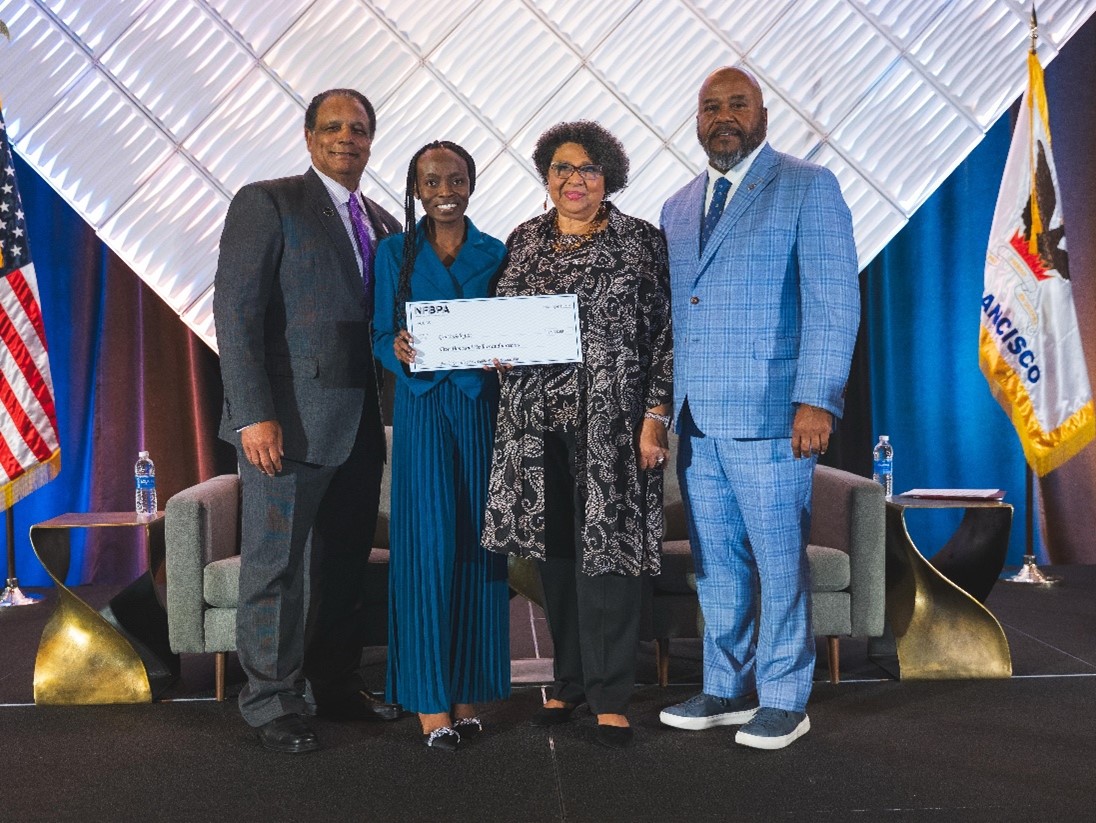
The defining moment of the forum was the presentation of the Jacobs Gabriele Mack Public Service Scholarship. Backed by Jacobs, a global powerhouse in engineering and environmental sustainability, operating in over 40 countries. The award champions scholars who seamlessly bridge academic rigor and public-sector implementation.
This year’s cohort of national awardees represented the next generation of systemic thinkers, featuring Daniel Akerele of the University of Washington, Juliet Booker of Hampton University, Darron Irving of Indian River State College, Comfort Aiyepada of the University of Georgia, and Zion Bradsher of the University of Kansas.
Yet, it was the pioneering work of Grace Balogun, a doctoral researcher in Bio-Environmental Sciences at Morgan State University, that captured the forum’s environmental sustainability honors. Her recognition signaled a definitive pivot toward addressing the most insidious ecological crisis of the 21st century: multi-pathway environmental exposure.
In both the United States and globally, environmental health is no longer threatened by single, easily contained pollutants. Research indicates that microplastics, once considered a marine issue predominantly, are now actively infiltrating terrestrial agriculture. When these particles interact with biological systems, they create a cascade of physiological disruption that ultimately enters the human food chain.
Balogun’s work was highlighted as a masterclass in intervention design. Instead of relying on multi-billion-dollar soil remediation projects that are often economically unfeasible, she engineered an elegant, scalable intervention. By deploying cerium oxide nanoparticles as redox-active catalysts, her methodology effectively “primes” plants to withstand toxic stress. This stabilizes crop health even in severely compromised environments, offering a low-cost defense mechanism for global agriculture.
During the award ceremony, Gabriele Mack articulated the profound relevance of this approach. The scholarship award, she noted, is “explicitly designed to recognize curiosity, dedication, and the potential to translate knowledge into impact.”
Mack’s endorsement underscored a critical truth in modern scientific fields: “academic achievement must translate into systems that function in the real world.”
By honoring Balogun, the NFBPA and Jacobs identified a researcher whose methodology provides an accessible blueprint for protecting vulnerable populations from the unseen dangers of environmental exposure.
“For decades, environmental protection has been a reactive game of trying to ‘un-pollute’ the soil,” Balogun explained. “My research flips that paradigm. By using nanotechnology to bio-hack a crop’s internal defenses, we aren’t just cleaning the dirt; we are arming the food system to thrive despite it.
Recognition from a titan like Jacobs proves that the global mandate has shifted: the most consequential science today isn’t what works in a lab, but what survives in the real world.”
This national recognition underscores a new reality in environmental protection. The most consequential scientific achievements no longer live entirely behind laboratory doors. Through the innovative integration of nanotechnology and agricultural sustainability.
Comments