



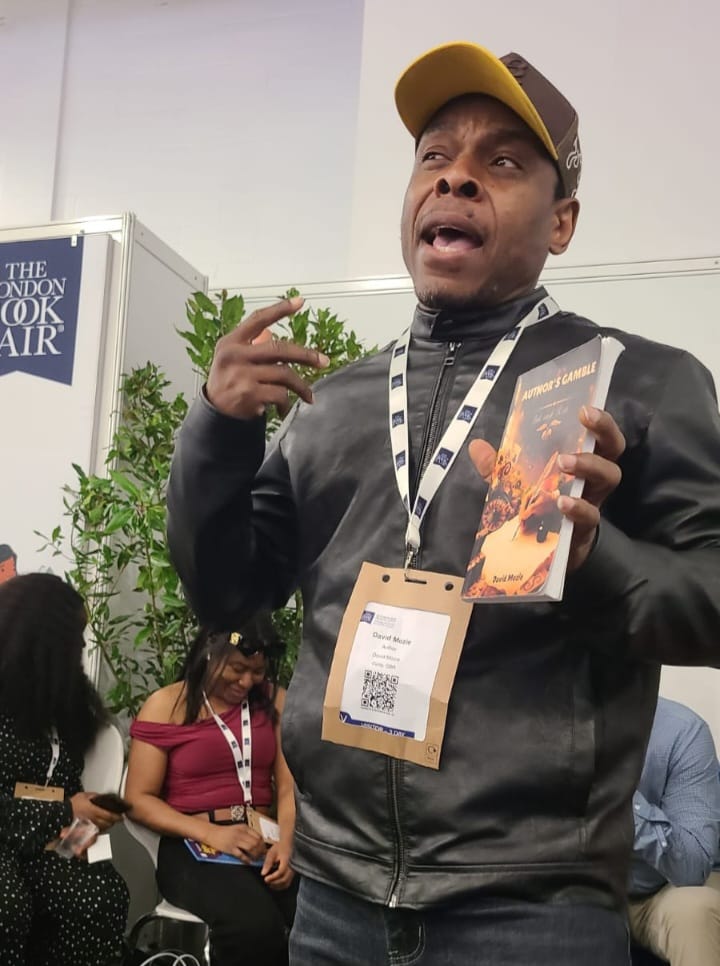
David Mozie’s ‘Author’s Gamble’ makes a bold case for writing as risk, not comfort – Haliru Ali Musa

 Quick Read
There is a test worth applying to any book about the writing life: does it make the act of writing feel more possible, or does it merely make the reader feel better about not doing it?
There is a test worth applying to any book about the writing life: does it make the act of writing feel more possible, or does it merely make the reader feel better about not doing it?
The distinction is sharper than it sounds. Consolation is easy. Genuine encouragement — the kind that names the difficulty accurately before offering any remedy — is considerably rarer, and more lastingly useful.
David Mozie’s Author’s Gamble: Ink and Risk belongs, for the most part, and with important qualifications, to the rarer category.
The book’s organising conceit is announced in its title and sustained across eight chapters: writing is a wager. Not metaphorically, in the loose way that all ambitious endeavours involve risk, but philosophically — in the sense that every creative act requires committing resources of time, identity, and emotional capital to an outcome that cannot be guaranteed.
Mozie pursues this claim with evident seriousness, and the fact that the gambling metaphor never quite collapses into gimmick across one hundred pages of material is itself a minor achievement in craft. Section headers — Placing Your Bets, The Stakes of the Gamble, The Market Gambit — do not merely label content; they argue for a way of understanding the writing life as fundamentally speculative, fundamentally hopeful, and dependent on the willingness to act without assured outcomes.
The book opens in the interior — with writer’s block, that defining humiliation of the creative life — and it is here that Mozie’s tone establishes itself most confidently.
Rather than treating the block as a productivity problem to be optimised away, he frames it as the writer’s inaugural encounter with creative risk: the first time the stakes of the wager become visible. The emotional and psychological dimensions of this experience — self-doubt, loneliness, and the shame of silence — are handled with a warmth that never tips into condescension.
This is a book that takes its reader’s fear seriously, which is a more significant achievement than it might appear. Most writing guides address fear in order to dismiss it. Mozie addresses it in order to honour it, and only then to move through it.
The third chapter contains the book’s finest sustained writing.
Constructing what he calls the “creative engine” — the integrated system of mindset, inspiration, and discipline that separates the aspiring writer from the working one — Mozie finds, in his section on journaling, the place where his governing metaphor operates at full strength.
“Your journal is your personal betting shop,” he writes. “You are constantly wagering that a forgotten memory, a stray observation, and a half-baked idea will somehow come together, paying out long odds on a flash of inspiration.”
This is the gambling conceit at its most illuminating — not decorating a familiar recommendation but transforming it, making visible the actual risk involved in private writing.
The follow-up — “you have to risk one to win the other” — lands with aphoristic force. These are sentences that will outlast the book that contains them.
The sixth chapter, on writing for social change, reveals the full scope of Mozie’s ambitions for the literary act.
Drawing on a lineage running from Enlightenment philosophers through Charles Dickens, Chinua Achebe, Arundhati Roy, and Chimamanda Ngozi Adichie, he contends that activist writing is literature operating at its most intentional — the moment the private wager of the writer becomes a public bet on the possibility of a more just world.
His analysis of narrative perspective as a moral tool is among the book’s most compelling passages: the reader, he observes, is not told that a certain group is persecuted; they are invited to live inside the experience of someone from that group.
He describes this as “an experiential simulator for a life other than one’s own,” a formulation that recalibrates how readers think about the ethics of fiction.
None of this is to suggest that Author’s Gamble: Ink and Risk is without significant problems.
The most consequential is the absence of real-world case studies. The book’s advice — on mindset, publishing, digital community, activist writing, and the challenges posed by artificial intelligence — is consistently sound, but it operates largely in the abstract.
Readers are told that agents and publishers are vital partners in managing risk, but are not shown a specific author navigating a concrete publishing decision and its consequences. Similarly, while building an email list is presented as a strategic response to algorithmic volatility, the book offers no detailed example of how this has worked — or failed — in practice.
This gap has also been noted in other assessments of the book, with critics arguing that the lack of case studies makes some of the guidance feel overly theoretical.
There are also structural issues. The conclusion’s retrospective survey contains a chapter-numbering error that omits the advocacy chapter — arguably the book’s most philosophically ambitious — from its final synthesis.
Given that Chapter Six argues that writing is inherently political and capable of reshaping public understanding, its omission is not trivial.
There is, in addition, a noticeable shift in register. At its best, the book balances intellectual seriousness with literary warmth. At other points — particularly in sections on publishing mechanics, digital platforms, and writing tools — the prose becomes more cautious and instructional, belonging to a less engaging framework.
The strongest chapters are those in which Mozie fully trusts his central metaphor. The weaker ones rely on business frameworks and app-based recommendations whose relevance may not endure.
Still, the book’s concluding imperatives — Take the risk. Spill the ink. Win the gamble. — land not as marketing slogans but as the logical culmination of its argument.
They are brief, declarative, and unafraid.
In that sense, they accurately reflect the book itself: imperfect, purposeful, and genuinely committed to the belief that writing is worth the cost of attempting it.
For writers who have ever faced a blank page and questioned whether their voice deserves to be heard, Author’s Gamble: Ink and Risk offers a compelling — if flawed — argument that it does.
Reviewer’s Bio
Haliru Ali Musa is a writer and critic from Katsina State, Nigeria, now based in Lagos. He writes The Long View, a weekly column in Naira Stories Magazine. His critical essays include “Three Wells, Three Wars: On the 2025 NLNG Prize Shortlist” and a study of Chukwuemeka Famous’ We Will Live Again.
His short story, “The Pregnant Ghost,” won the inaugural 2024 Alexander Nderitu Prize for World Literature.
Comments