


How Companies in Emerging Markets Are Improving Project Efficiency and Reducing Costs


 Quick Read
The companies pulling ahead in their markets are those that recognize project management not as an administrative discipline but as a strategic one. They invest in the visibility, governance, and cultural changes that allow them to deliver their portfolios reliably.
A construction firm in Lagos recently completed a portfolio review that had been postponed for nearly two years. The findings were sobering. Of forty-three active projects, thirty-one were running behind schedule, eighteen were over budget, and at least nine were duplicating work already underway in other parts of the company. None of these problems were the result of incompetence or weak intent. They were the predictable outcome of trying to manage a growing portfolio with the same operational tools the firm had used when it ran ten projects, not forty. The story is not unique to Lagos. Variations of it are playing out in Nairobi, Mumbai, Jakarta, São Paulo, and Manila – anywhere the pace of business growth has outstripped the maturity of the systems organizations use to direct it.
Companies in emerging markets are increasingly recognizing that operational efficiency is no longer a peripheral concern but a central determinant of competitive survival. Margins are tighter than in mature economies, capital is more expensive, and the talent that drives project delivery is both scarcer and more mobile. In this environment, the cost of a poorly managed project portfolio is paid in three currencies at once: financial waste, lost market opportunities, and the departure of skilled people who refuse to spend their careers fighting avoidable chaos. The firms that are pulling ahead in these markets are the ones treating project efficiency as a strategic capability rather than an administrative function.
The Particular Pressures of Emerging Market Project Delivery
Project work in emerging markets carries a structural complexity that is often underappreciated by observers in mature economies. The same project – whether a new product launch, an infrastructure build, an IT system implementation, or a regulatory compliance initiative – must be delivered against a backdrop of currency volatility, regulatory shifts that arrive with little notice, supply chain disruptions that have nothing to do with the company’s own decisions, and a labor market where retaining experienced project managers requires both compensation and conditions that smaller firms struggle to provide.
These external pressures interact in ways that compound risk. A delayed import shipment caused by port congestion can push a project beyond a contractual deadline. The contractual penalty consumes margin already squeezed by exchange rate movements. The financial pressure forces difficult decisions about which other projects in the portfolio must be slowed to free up cash. Each of these decisions, made under pressure and with incomplete information, generates secondary effects that ripple through the rest of the operation for months. Companies that lack a clear, real-time view of their full project portfolio find themselves making consequential decisions in conditions of partial blindness, often discovering the full impact only when the next quarterly review arrives.
A related challenge is the heavy reliance on personal networks and informal coordination that characterizes business culture across many emerging markets. These networks are genuine assets – they enable rapid trust-building, flexible problem-solving, and the navigation of bureaucratic environments that more formalized approaches cannot match. But they also create an organizational pattern where critical project information lives primarily in people’s heads, in WhatsApp threads, or in spreadsheets that only one person fully understands. When a key project manager leaves, takes extended leave, or is reassigned, an enormous amount of operational knowledge can leave with them. The next person to inherit the project often spends weeks reconstructing context that should have been documented from the beginning.
What the Most Effective Companies Are Doing
The organizations achieving genuine improvements in efficiency across these conditions tend to share a small number of strategic shifts in how they think about project work. The shifts are not dramatic in isolation, but their cumulative effect is substantial.
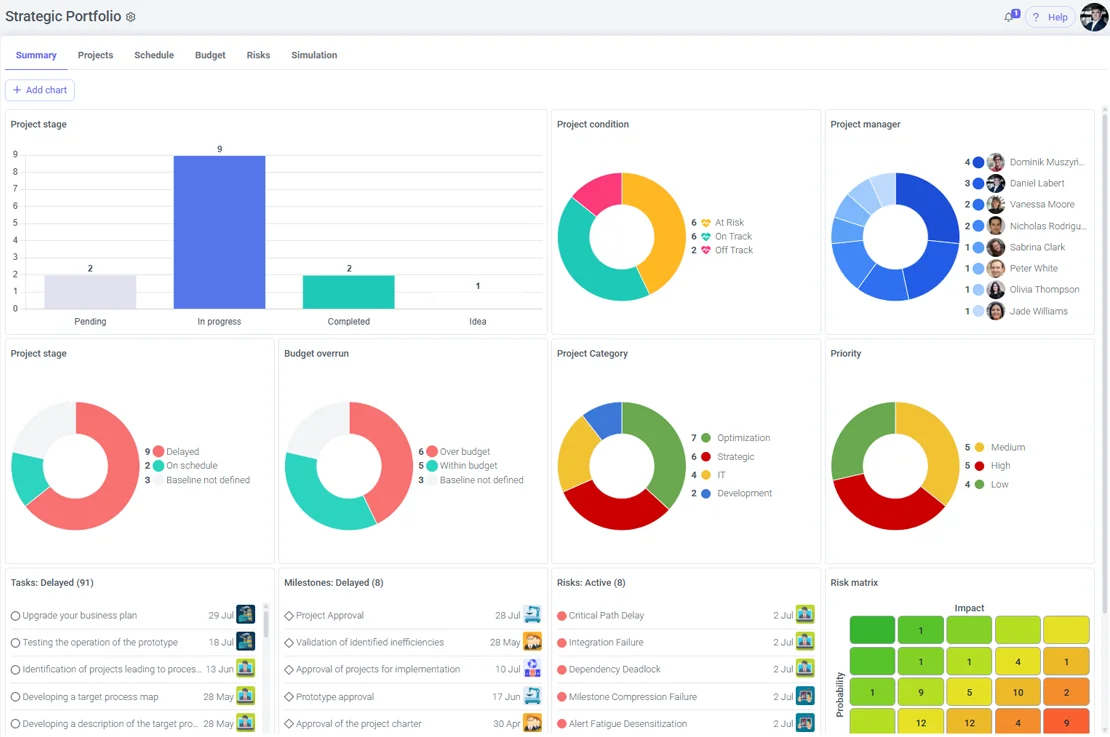
The first shift is the recognition that portfolio-level visibility is not optional once a company crosses a certain threshold of complexity. For a firm running five or six concurrent initiatives, informal coordination through meetings, emails, and direct conversations is often adequate. For a firm running thirty or fifty, the same approach guarantees that some projects will receive too much attention while others quietly drift toward failure. Companies that have successfully scaled their project operations almost universally invest in centralized portfolio infrastructure – not because they enjoy bureaucracy, but because they have learned the hard way that the alternative is more expensive.
The second shift involves how decisions get made about what to start, continue, or stop. Many emerging market companies, especially those experiencing rapid growth, accumulate projects faster than they retire them. Each new initiative seems individually justified at the moment of approval. The cumulative weight of these accumulated commitments eventually exceeds the organization’s capacity to deliver any of them well. The firms that have escaped this trap have done so by introducing structured portfolio reviews – regular sessions where leadership genuinely confronts the question of which projects deserve continued investment, which should be paused, and which should be terminated outright. These conversations are uncomfortable. Projects have champions, sunk costs, and political weight. But the discipline of holding them transforms how an organization spends its scarce execution capacity.
The third shift concerns the role of data. In environments where decisions have traditionally been made through experience, intuition, and personal judgment, introducing data-driven project oversight can feel like a cultural imposition. The most effective implementations recognize this and treat data as a tool that supports judgment rather than replaces it. A skilled project director still makes the final call on whether to escalate a risk, but the decision is informed by quantitative information about resource utilization, schedule variance, and dependency status that simply was not visible before. Data does not eliminate the need for experienced judgment; it ensures that experienced judgment is applied to accurate information.
The fourth shift is the most difficult: building an organizational culture in which raising bad news early is rewarded rather than punished. In many emerging market business environments, hierarchical respect and the importance of maintaining face create powerful disincentives against early problem disclosure. Project managers learn that flagging a likely delay three months out generates more immediate criticism than allowing the same delay to surface as a fait accompli closer to the deadline. The companies that have moved past this pattern have done so through deliberate leadership behavior – senior executives consistently demonstrating that early disclosure is treated as a contribution rather than a confession. The cultural change takes time, but the operational benefits are profound.

The Role of Technology and Specialized Platforms
Tools alone cannot solve organizational problems, but the right tools can make organizational improvements feasible at scales where they would otherwise be impractical. The technology landscape for project management has matured significantly over the past decade, and platforms that were once accessible only to large enterprises with substantial IT budgets are now available to mid-sized firms across emerging markets at price points that fit local economic realities.
The most useful systems for these companies are not the most feature-rich, but the ones that match the actual maturity of the organization’s processes. A company still working out its basic project governance gains little from sophisticated portfolio analytics it does not yet have the discipline to act on. The same company will benefit enormously from a single, shared environment where active projects, their current status, the people assigned to them, and the budgets they consume can be seen at a glance by everyone with legitimate need.

This is the role that platforms such as Flexi Project increasingly play in modernizing project operations across emerging market companies. A unified planning, resource allocation, and reporting environment replaces the patchwork of spreadsheets, email threads, and disconnected tools that quietly consume so much organizational energy. Status meetings transform from data-collection exercises into genuine working sessions because everyone is operating from the same information. Resource conflicts surface early enough to be resolved through reallocation rather than crisis. Underperforming initiatives become visible before they consume disproportionate budget, allowing leadership to redirect investment toward work that actually advances strategic priorities.
For organizations that have moved beyond basic project tracking and are ready to operate at portfolio scale, dedicated PMO software adds capabilities that change the nature of executive decision-making entirely. Scenario modeling allows leadership to see what happens to the rest of the portfolio if a particular initiative is accelerated, deferred, or canceled. Capacity simulation reveals whether the organization can realistically absorb a proposed new project without compromising existing commitments. Strategic alignment dashboards make explicit the connection between resource flows and corporate strategy, surfacing the gap that often exists between what an organization says it values and where its execution capacity actually goes.
The shift toward these platforms is sometimes characterized as a technology adoption story, but the deeper change is operational. What these tools enable is a different kind of management – one in which decisions are made on the basis of current, accurate information rather than reconstructed assumptions, and one in which the entire organization can coordinate its collective effort with a coherence that informal methods cannot achieve at scale.
Cost Reduction as a Consequence, Not a Goal
It is worth examining the relationship between operational efficiency and cost reduction, because the connection is often misunderstood. Companies that approach cost reduction as a primary objective frequently end up cutting in places that damage their long-term capability. They reduce headcount in functions that produce no immediate visible output, postpone investments in infrastructure whose absence will be felt only later, and delay improvements whose payback is genuine but difficult to quantify in the current quarter. These cuts produce short-term savings that often reverse themselves, with interest, over the following two or three years.
The companies achieving sustainable cost reductions through better project management are operating from a different premise. They focus on improving the operational system, on the understanding that a more efficient system consumes fewer resources to produce the same output. Eliminating duplicated work across projects reduces costs without reducing capability. Surfacing capacity conflicts early prevents the expensive last-minute fixes that always cost more than proactive resolution. Terminating underperforming initiatives before they consume their full budgets frees capital for work that will actually deliver value. None of these involve cuts to capability; they involve removing the inefficiencies that previously absorbed resources without producing returns.
Industry data tracking project performance in emerging markets suggests that the magnitude of these savings is substantial. Companies implementing structured portfolio management commonly report reductions of fifteen to twenty-five percent in project cost overruns, comparable improvements in on-time delivery rates, and significant reductions in the volume of work that has to be redone because earlier stages were not properly coordinated. These are not marginal improvements. For an organization spending tens of millions of dollars annually on project work, even the lower end of this range translates into meaningful capital that can be redirected toward growth.
The labor cost picture is particularly important in markets where retaining skilled project managers is both expensive and difficult. Organizations operating in chronic chaos lose senior talent to better-managed competitors at predictable rates, and each loss carries replacement costs that include not only recruitment but also the months of reduced productivity while the new hire builds context. Companies that invest in operational coherence find that their retention of senior project staff improves measurably, often paying back the investment in management infrastructure within the first year through reduced turnover alone.
Building the Capability Gradually
For companies considering how to move toward better project management, the most consistent advice from those who have successfully made the transition is to avoid attempting too much at once. The pattern of success is incremental rather than revolutionary. Organizations that try to install a comprehensive portfolio management system, retrain their entire project workforce, and rewrite their governance processes simultaneously generally fail. The complexity overwhelms the organization’s capacity to absorb change, and the initiative collapses under its own weight.

The more reliable path involves sequencing improvements over twelve to eighteen months. The first phase typically focuses on visibility – establishing a single, accurate view of what projects are underway, what they are costing, and what resources they consume. This step alone often reveals so much previously hidden information that organizations spend several months simply digesting it. The second phase introduces structured prioritization and portfolio review, building the discipline of making explicit choices about where the organization’s effort should go. The third phase brings analytical depth, enabling scenario modeling, capacity planning, and the kind of forward-looking analysis that separates well-managed portfolios from merely visible ones.
Throughout this progression, the technology serves the organizational change rather than driving it. Tools deployed before the underlying processes are ready tend to be used in name only, generating reports that nobody references and dashboards that nobody trusts. Tools deployed in support of processes that the organization has already decided to adopt produce dramatically different outcomes. The companies that have made this transition successfully are nearly unanimous on this point: get the operating model right, then deploy the technology that enables it to scale.
A Strategic Inflection Point
Emerging market companies operate in conditions that demand operational excellence as a baseline rather than an aspiration. The volatility of their environments, the scarcity of their capital, and the mobility of their skilled labor leave little room for the operational waste that more cushioned competitors in mature economies can sometimes absorb. The good news is that the systems, methods, and tools required to operate at a high level of project efficiency are now genuinely accessible. The constraint is no longer access to capability; it is the organizational will to adopt it.
The companies pulling ahead in their markets are those that recognize project management not as an administrative discipline but as a strategic one. They invest in the visibility, governance, and cultural changes that allow them to deliver their portfolios reliably. They treat data as a complement to judgment rather than a substitute for it. They build their operational capability gradually but persistently, accumulating advantages that compound over years. The companies still managing forty projects with the methods that worked for ten are not failing because they lack ambition or talent. They are failing because the methods themselves cannot scale, and continuing to use them is a strategic choice with predictable consequences.
For business leaders considering where to focus their efforts in the coming period, the operational layer of their organization deserves more attention than it usually receives. The competitive advantages it produces are less visible than those generated by new products or new markets, but they are also more durable. A well-run project portfolio is not a glamorous asset, but it is one of the most reliable sources of compounding value any organization can build – and in emerging markets, where the cost of operational chaos is amplified by every external pressure, it may be the most important asset of all.
Comments