


If Subsidy Is Gone, Why Is Nigeria Still Borrowing?

 Quick Read
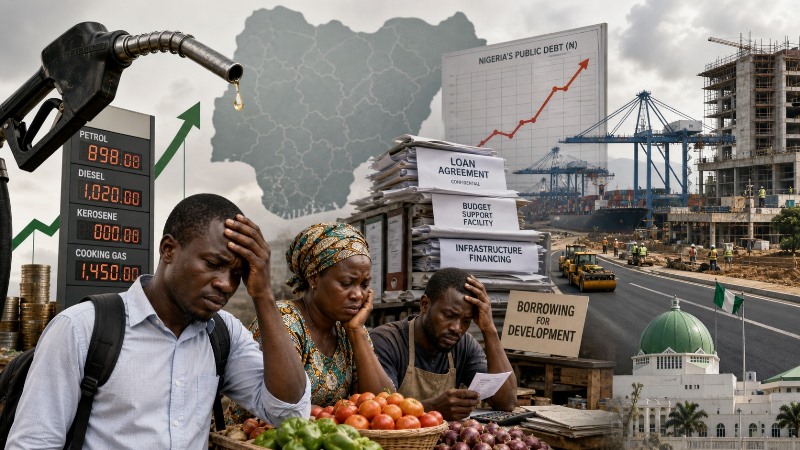
The National Assembly’s approval of President Bola Ahmed Tinubu’s $6 billion external loan request has reopened a question many Nigerians are already asking: if fuel subsidy has been removed, why is the country still borrowing?
By Olaoluwa Vincent Ajayi
New Daily Prime
Economics Writer
The National Assembly’s approval of President Bola Ahmed Tinubu’s $6 billion external loan request has reopened a question many Nigerians are already asking: if fuel subsidy has been removed, why is the country still borrowing?
It is a fair question. Nigerians were told for years that subsidy was one of the biggest drains on public finances. So, after its removal, many expected government borrowing to slow down. Instead, the country is still seeking loans, while public debt continues to rise.
Figures from the Debt Management Office show that Nigeria’s total public debt stood at about ₦153.29 trillion as of September 30, 2025. There are also concerns that the debt could rise further as the government funds budget deficits and infrastructure projects.
For ordinary citizens, this debate is not just about figures. It is about transport fares, food prices, school fees, rent, business costs and salaries that no longer carry the same value. Many people want to know why they are still making sacrifices if the government is still borrowing.
Subsidy Was Not the Only Problem
Nigeria still has low revenue, high debt-service costs, weak infrastructure, foreign exchange pressure and a large budget deficit. In simple terms, the country still spends more than it earns. Removing subsidy reduced one heavy burden, but it did not suddenly repair years of fiscal pressure.
This was the government’s strongest argument in the President’s letter to the Senate on March 31, 2026. The letter said borrowing was still needed to support budget implementation, fund development, invest in priority infrastructure projects and refinance expensive debts. Part of the approved loan is expected to support infrastructure, including the rehabilitation of the Lagos Port Complex and Tin Can Island Port.
The Real Problem Is Wasteful Borrowing
A country can borrow to build roads, ports, rail lines, power projects, schools and hospitals. These are investments that can support trade, create jobs and attract investors. But when borrowed money is poorly managed or used mainly for consumption, it becomes a burden on future generations.
The Tinubu administration has set a target of building a $1 trillion economy by 2030. That target will not be achieved by speeches alone. Nigeria needs stable policies, better infrastructure, stronger revenue collection, private-sector growth and investor confidence. These require money, discipline and time.
The Real Source of Subsidy Funding
Fuel subsidy was introduced decades ago to keep petrol prices low. For many years, the government paid part of the cost so citizens could buy fuel below the market price. At first, it looked like direct support for the people. Over time, it became one of the biggest drains on public revenue.
Money that could have gone into roads, hospitals, schools, power and security was used to keep petrol prices low. State governments also received less money because subsidy payments reduced the amount available for sharing. The World Bank said petrol subsidy removal could save Nigeria about ₦2 trillion in 2023 and more than ₦11 trillion by the end of 2025.
Taiwo Oyedele, who is now the Minister of Finance and Coordinating Minister of the Economy, had earlier argued that Nigeria’s fiscal position was under severe pressure. The Central Bank also reported that Nigeria recorded a balance of payments deficit of $3.34 billion in 2023 before posting a surplus in 2024.
Nigeria also relied heavily on Central Bank financing through Ways and Means advances. The Debt Management Office said the inclusion of ₦22.7 trillion in securitised Ways and Means advances was a major reason Nigeria’s public debt rose sharply in 2023.
That means subsidy and other spending pressures were not always being paid from surplus money. Nigeria was borrowing, using Central Bank support and pushing future obligations forward. That path was dangerous. If subsidy had continued without reform, debt servicing could have swallowed more government revenue. There would have been less money for salaries, security, roads, hospitals, schools and other basic needs.
Still, the pain Nigerians are facing cannot be dismissed. Transport fares have risen. Food prices remain high. Small businesses are struggling. Workers are under pressure. Many families are cutting down on basic needs. The government may be right that subsidy had to go, but citizens are also right to demand proof that their sacrifice is not being wasted.
That is where accountability comes in, Nigerians deserve to know the interest rate on the new loans, the repayment period, the projects to be funded, who will monitor the spending and how the money will improve jobs, infrastructure and living standards.
The issue now is not borrowing alone. It is trust. The Tinubu administration can argue that it inherited a difficult economy and is trying to prevent a deeper crisis. That argument has weight. But Nigerians will judge the government by results, not promises.
Fuel subsidy may have been too costly to continue. Borrowing may also be necessary to fund growth. But both policies will only earn public support if they produce visible results.
The real test is simple: will the borrowed money build an economy strong enough to repay its debts, create jobs and improve the lives of ordinary Nigerians?
Comments