



Nigerian Journalist Unveils First In-Depth Book on U.S. Capture of Venezuelan President

 Quick Read
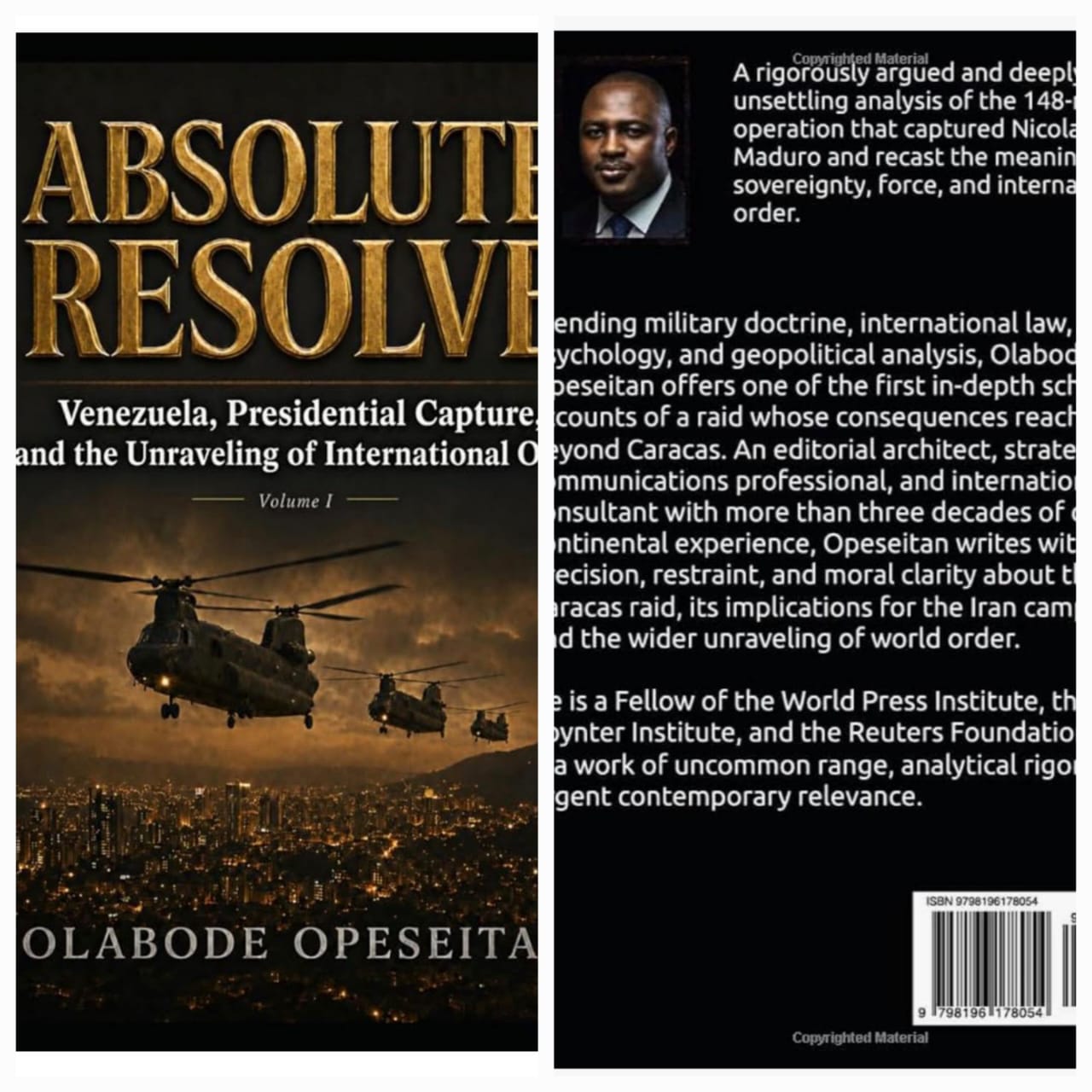
A Nigerian journalist and Fellow of the World Press Institute, Olabode Opeseitan, has unveiled the first comprehensive analytical book on the January 3, 2026, military operation by the United States to capture the Venezuelan President, Nicolás Maduro.
A Nigerian journalist and Fellow of the World Press Institute, Olabode Opeseitan, has unveiled the first comprehensive analytical book on the January 3, 2026, military operation by the United States to capture the Venezuelan President, Nicolás Maduro.
Opeseitan, who is also a Fellow of the Poynter Institute and the Reuters Foundation, in the book titled “Absolute Resolve,” dissected the wider implications of the U.S. operation on the international order and how satellite intelligence, human intelligence, cyber warfare, electronic warfare, and multi-domain kinetic force fused into a single 148-minute operational template had permanently changed the grammar of war.
President Maduro was captured by U.S. forces on January 3 at exactly 3:29 a.m. Caracas time in his bedroom at Fort Tiuna military base. By 4:15 a.m., he was aboard a U.S. Navy vessel in international waters. Within hours, he was transferred to federal detention in Miami.
Opeseitan, a strategic analyst and international consultant, described President Maduro’s capture, via the raid tagged “Operation Absolute Resolve,” as the most consequential act of American unilateral power since the invasion of Iraq.
In the landmark work, Opeseitan examined the raid not simply as a military event, but as a complex intersection of technology, psychology, institutional dynamics, international law, and geopolitical power.
In the book description on Amazon, the author analysed why Fort Tiuna’s 5,000 troops mounted no coordinated defence — and what that silence reveals about the psychology of authoritarian collapse.
He provided an engaging context to how the President Donald Trump administration’s “law enforcement” legal framing bypassed the War Powers Resolution — and why Congress failed to stop it.
Another incisive part of the book is how Opeseitan interpreted what Russia, China, Iran, and America’s own allies absorbed from the Caracas template — and how the nuclear, cyber, and financial proliferation ratchets are already turning.
He also discussed the 83 lives lost in Venezuela, 13 American soldiers in Iran, and the institutional absence of any mechanism that required a president to confront that cost before giving the order.
“Governing through extraction without reciprocation, demanding loyalty while offering betrayal — Maduro’s regime encoded its own collapse. But the deeper question this book pursues is not how he fell. It is what his fall revealed about the international order that permitted it, enabled it, and may never fully recover from it.
“The hegemon that exempts itself from the rules it enforces does not weaken the rules alone. It weakens the only argument it ever had for being obeyed,” Opeseitan said.
Spanning twelve chapters, one epilogue, and a comprehensive conclusion, Absolute Resolve draws on military doctrine, international law, intelligence analysis, behavioral economics, moral philosophy, and open-source reporting to deliver a work of scholarly rigor and urgent relevance.
Giving further insights, Opeseitan said: “Every substantive claim is footnoted. Every inference is labeled. Every question left open is acknowledged.
“This is Volume I of a multi-volume series. The grammar of war has changed. This book explains how — and what comes next.”
The book, which was independently published on May 9, 2026, is now live and available
Comments