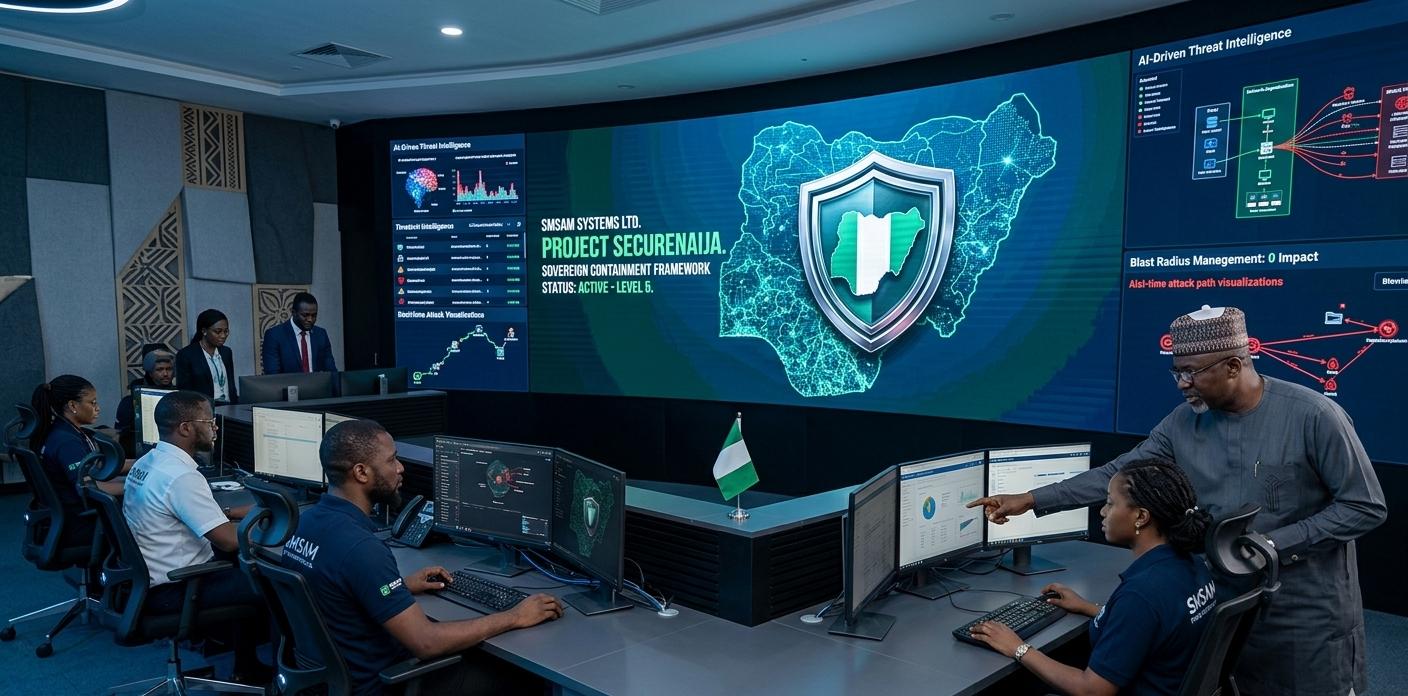
As cyberattacks continue to threaten Nigeria’s financial services and payment infrastructure, Lagos-based cybersecurity firm SMSAM Systems Ltd has launched Project SecureNaija, a new cybersecurity framework tailored to Nigeria’s operational and regulatory environment.
The company introduced the initiative as organisations across banking, fintech, and telecommunications sectors continue to battle rising cyber threats, weak security structures, and increasing pressure to secure digital operations.
According to the organisation, many Nigerian institutions still rely on outdated or poorly adapted security systems that struggle to address local operational realities.
“While digital transformation has accelerated rapidly, many organisations continue to face challenges such as weak access controls, poor network segmentation, delayed threat detection, and inefficient incident response systems.
Cybersecurity Ventures estimates that global cybercrime damages could reach $10.5 trillion annually, while ransomware attacks, credential theft, and infrastructure breaches continue to rise across Africa. Nigeria’s expanding digital economy has increasingly attracted cybercriminal activity, making stronger cybersecurity systems a growing priority for both private and public institutions.
“To address these challenges, SMSAM Systems developed Project SecureNaija as a containment-focused cybersecurity framework designed specifically for Nigerian institutions,” the company stated.
The company added that the initiative combines internationally recognised standards such as NIST CSF, ISO 27001, and MITRE ATT&CK with compliance structures aligned to Nigeria’s NDPR, CBN Cybersecurity Framework, and NCC regulations.
According to the company, the framework actively monitors Nigeria-specific cyber threats through continuous threat intelligence systems that identify emerging risks and suspicious activities across digital environments.
SMSAM Systems also integrated zero-trust containment architecture into the framework to restrict lateral movement during cyber breaches and reduce the spread of attacks within institutional networks.
The company further deployed AI-augmented detection systems that use behavioural analytics tailored to local infrastructure conditions to improve early threat identification and response accuracy.
To strengthen recovery efforts, Project SecureNaija includes AI-assisted incident response mechanisms that provide structured response playbooks designed to help organisations contain attacks and recover operations quickly.
The framework also supports regulatory compliance by mapping governance structures against Nigerian cybersecurity regulations, helping institutions reduce exposure to compliance risks and operational penalties.
Speaking on the initiative, SMSAM Systems said many cybersecurity models fail because they overlook Nigeria’s unique infrastructure, regulatory, and operational realities.
“Cybersecurity strategies cannot be effective in Nigeria if they ignore the country’s operational, regulatory, infrastructure, and talent realities,” the company stated.
As Nigeria’s digital ecosystem continues to expand, cybersecurity experts believe localised defence systems such as Project SecureNaija could play an important role in strengthening operational continuity, protecting public trust, and improving confidence in the country’s digital infrastructure.


 Quick Read
Comments