



Nigeria, US fresh airstrikes kill over 20 ISWAP fighters in Borno

 Quick Read
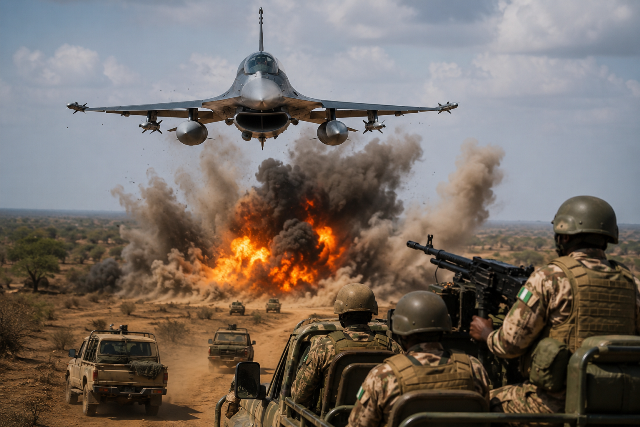
The Defence Headquarters on Monday announced that Nigerian troops, working in coordination with the United States Africa Command, AFRICOM, carried out fresh airstrikes that killed more than 20 fighters of the Islamic State West Africa Province, ISWAP, in Nigeria’s North-East region.
By Kazeem Ugbodaga
The Defence Headquarters on Monday announced that Nigerian troops, working in coordination with the United States Africa Command, AFRICOM, carried out fresh airstrikes that killed more than 20 fighters of the Islamic State West Africa Province, ISWAP, in Nigeria’s North-East region.
According to the military, the coordinated precision strikes targeted terrorist hideouts around Metele in Borno State after intelligence reports confirmed the movement and gathering of insurgents within the area.
The operation, conducted on May 17, 2026, formed part of intensified joint counterterrorism efforts aimed at crippling terrorist networks, dismantling insurgent strongholds and preventing fighters from regrouping.
In a statement issued by the Director of Defence Information, Maj. Gen. Samaila Uba, the military said the latest offensive was a continuation of sustained operations against ISIS-linked militants operating in the North-East.
“The Defence Headquarters, in close coordination with United States Africa Command, wishes to update the general public on the continuation of coordinated operations against ISIS militants across North-East Nigeria,” the statement said.
The military disclosed that surveillance and intelligence operations detected a fresh convergence of terrorist elements in the area, prompting a series of calculated air assaults that successfully neutralised dozens of ISWAP fighters.
According to the statement, the coordinated strikes were designed to flush insurgents out of their enclaves, disrupt planned attacks and restore security across affected communities.
The United States Africa Command also confirmed the operation in a separate statement issued by its Public Affairs Office in Stuttgart, Germany.
AFRICOM said intelligence gathered before the strikes confirmed that the targets were ISIS militants and added that post-strike assessments were still ongoing.
The command, however, confirmed that no Nigerian or United States personnel were harmed during the operation.
“The removal of these terrorists diminishes the group’s capacity to plan attacks that threaten the safety and security of the U.S. and our partners,” AFRICOM stated.
The latest offensive underscores deepening military cooperation between Nigeria and the United States in combating terrorism and extremist violence in the Lake Chad region.
Reaffirming the resolve of the Armed Forces, Maj. Gen. Uba said Nigerian troops would sustain aggressive operations against insurgents threatening national security.
“Terrorists who threaten our citizens, communities, and national stability will be located and defeated. There will be no safe haven for terrorists anywhere in Nigeria,” he declared.
The fresh operation comes days after United States President Donald Trump and Nigerian President Bola Tinubu confirmed the killing of notorious ISIS commander, Al-Minuki, during another joint counterterrorism mission involving Nigerian and American forces.
Trump had described Al-Minuki as one of the world’s most dangerous terrorists and claimed the slain extremist was regarded as ISIS’ second-in-command globally.
According to the US President, the terrorist leader believed Africa would shield him from capture before he was eventually tracked and eliminated during the operation.
Security analysts say the renewed coordinated strikes signal increasing pressure on ISWAP and other extremist factions operating within Nigeria’s troubled North-East corridor.
Comments