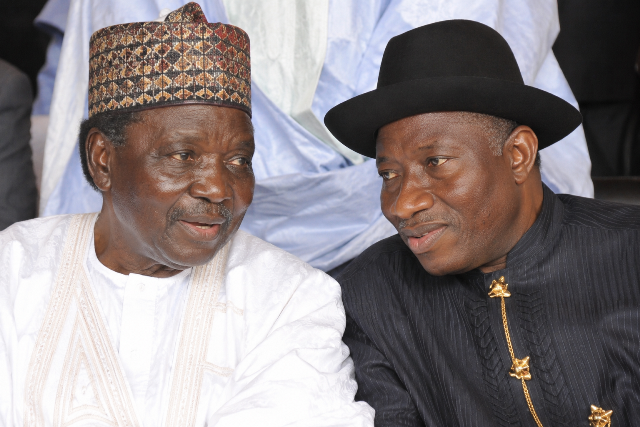
Former President Goodluck Jonathan on Tuesday offered a rare, reflective tribute to former Head of State General Yakubu Gowon, arguing that many of the policies introduced during Gowon’s tumultuous tenure remain strikingly relevant to Nigeria’s contemporary challenges.
Speaking as chairman of the public presentation of Gowon’s autobiography, My Life of Duty and Allegiance, in Abuja, Jonathan framed Gowon’s leadership not merely as a historical artefact but as a continuing reference point for national cohesion and regional integration.
“Many people can be good leaders when the environment is stable. It is during periods of crisis that true leadership is revealed,” Jonathan said, drawing attention to Gowon’s assumption of power as a young officer during one of Nigeria’s most perilous moments-the civil war.
Rather than dwell solely on the wartime narrative, Jonathan emphasised Gowon’s post-war magnanimity.
He singled out the declaration of “No victor, no vanquished” as a philosophical anchor that enabled the country to begin healing from a brutal conflict that still echoes in Nigerian memory.
“That philosophy laid the foundation for healing, reconstruction and reintegration,” Jonathan noted.
Perhaps the most striking section of Jonathan’s address was his personal testimony regarding the National Youth Service Corps (NYSC), which Gowon established in 1973.
While many commentators have debated the scheme’s effectiveness over five decades, Jonathan offered a tangible, intimate endorsement.
He recalled how two corps members-Mr. Balogun and Mr. Ojukwu, were posted to his secondary school in 1973 and taught him core science subjects, significantly shaping his academic trajectory.
“So, the vision of the NYSC was great, and we will continue to celebrate you,” he said directly to Gowon.
However, Jonathan also conceded that the scheme’s original objective, to reorient young Nigerians and foster genuine national unity, remains incompletely realised.
He lamented that “some politicians still speak as though Nigeria were in the pre-1914 era,” a pointed critique of contemporary ethnic and regional rhetoric that continues to undermine the very unity the NYSC was designed to cultivate.
Beyond domestic policy, Jonathan praised Gowon’s role in founding the Economic Community of West African States (ECOWAS), describing it as another enduring initiative that continues to drive regional integration and cooperation.
“These are policies that will continue to reform society. These are policies that will endure,” Jonathan said, implicitly contrasting long-term institutional thinking with the short-termism that often characterises modern governance.
The former president also stressed the importance of political memoirs, noting that works like Gowon’s help preserve institutional memory and enrich public understanding of leadership. In a notable aside, Jonathan hinted that he may eventually document his own experiences, suggesting a future autobiography of his own.
Jonathan did not limit his praise to Gowon’s years in power. He highlighted the former head of state’s continued engagement through initiatives such as “Nigeria Prays” and other peace-building efforts.
“Through such engagements, he has shown that true leadership does not end with political authority. It continues in service to humanity,” Jonathan said.


 Quick Read
Comments