


Nigeria’s GDP grows by 3.89% in first quarter of 2026

 Quick Read
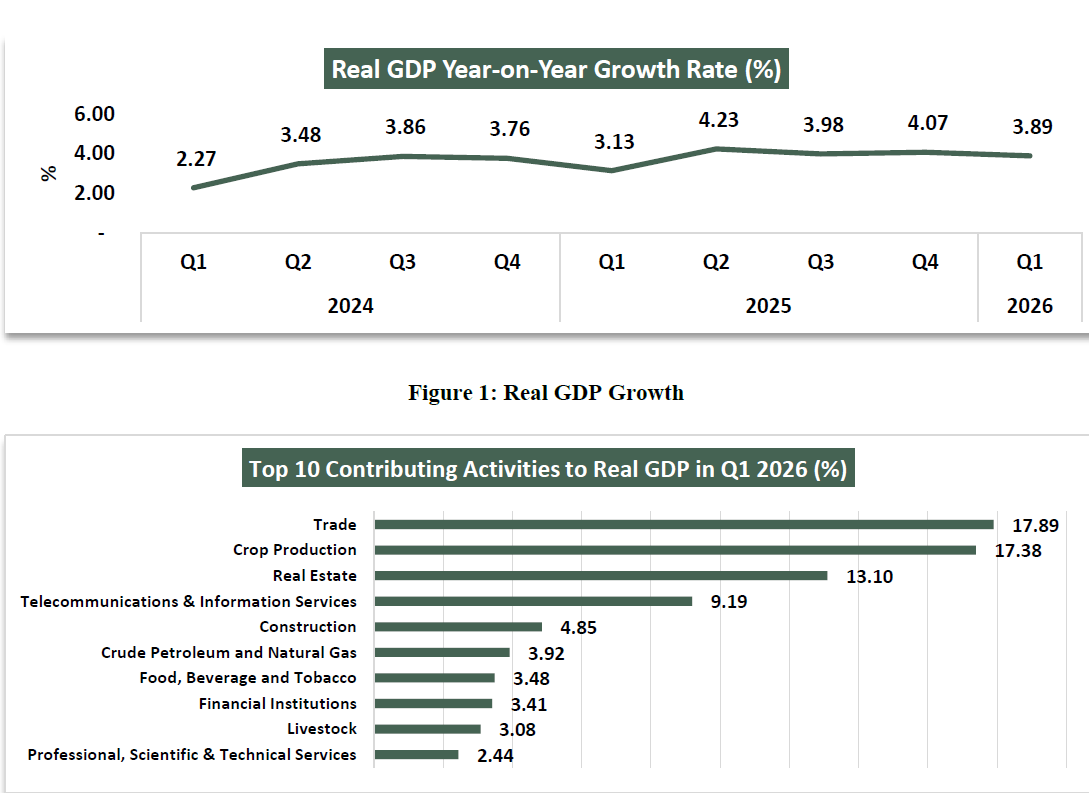
Nigeria’s Gross Domestic Product (GDP) grew by 3.89 per cent in real terms in the first quarter of 2026, reflecting stronger economic activities across key sectors of the economy despite persistent inflationary pressures and declining crude oil production.
Nigeria’s Gross Domestic Product (GDP) grew by 3.89 per cent in real terms in the first quarter of 2026, reflecting stronger economic activities across key sectors of the economy despite persistent inflationary pressures and declining crude oil production.
The latest GDP report released by the National Bureau of Statistics (NBS) on Monday, showed that the growth rate exceeded the 3.13 per cent recorded in the corresponding quarter of 2025, indicating improved performance in telecommunications, agriculture, trade, construction, financial services and other non-oil sectors.
According to the report, Nigeria’s economy was largely driven by the non-oil sector, which contributed 96.08 per cent to total real GDP during the quarter under review, while the oil sector accounted for 3.92 per cent.
The NBS disclosed that aggregate GDP at basic prices stood at N110.79 trillion in nominal terms in Q1 2026, representing a year-on-year nominal increase of 17.79 per cent compared to N94.05 trillion recorded in the first quarter of 2025.
The report showed that the non-oil sector expanded by 3.94 per cent in real terms, driven by robust activities in telecommunications, crop production, trade, cement manufacturing, financial institutions, real estate, construction and road transportation.
Telecommunications and information services emerged as one of the strongest-performing sectors, recording a real growth rate of 10.98 per cent year-on-year.
The sector contributed 11.31 per cent to Nigeria’s real GDP during the quarter, higher than the 10.59 per cent contribution recorded in the corresponding period of 2025.
Agriculture also posted stronger growth, expanding by 3.15 per cent in real terms compared to the marginal 0.07 per cent growth recorded in Q1 2025.
The sector contributed 23.16 per cent to aggregate real GDP, with crop production remaining the dominant agricultural activity, accounting for 66.76 per cent of the sector’s nominal value.
Trade remained one of the largest contributors to economic output, accounting for 17.89 per cent of real GDP, while real estate contributed 13.10 per cent.
The finance and insurance sector recorded an 8.54 per cent growth rate, while construction grew by 6.38 per cent during the quarter.
Despite weaker crude oil production, the oil sector still recorded a 2.57 per cent real growth in Q1 2026, improving from the 1.87 per cent growth posted in the corresponding quarter of 2025.
However, average daily crude oil production declined to 1.55 million barrels per day from 1.62 million barrels per day recorded in the first quarter of last year.
The report also revealed mixed sectoral performances across the economy.
While the arts, entertainment and recreation sector expanded strongly by 11.25 per cent, the electricity, gas, steam and air conditioning supply sector contracted sharply by 15.30 per cent in real terms.
Education recorded a modest growth rate of 1.22 per cent, lower than the 2.47 per cent achieved in the corresponding quarter of 2025.
According to the NBS, the leading contributors to Nigeria’s real GDP in the first quarter of 2026 were trade, crop production, real estate, telecommunications and information services, crude petroleum and natural gas, construction, food and beverages, financial institutions and livestock.
Comments