


2027: ‘Jonathan not interested, will not challenge President Tinubu’

 Quick Read
The source further maintained that Jonathan neither purchased nor submitted any nomination form and did not participate in any screening exercise conducted by the PDP faction.
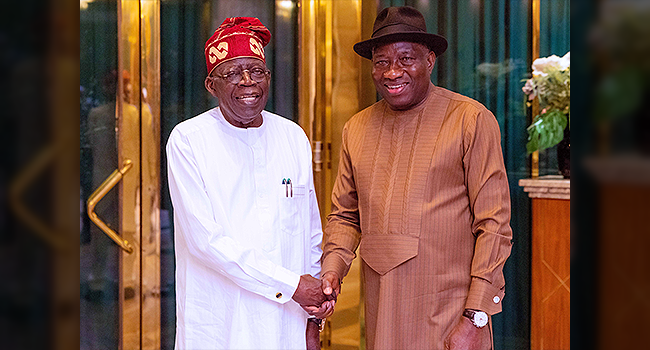
Former President Goodluck Jonathan’s continued silence over his purported adoption by a faction of the Peoples Democratic Party (PDP) is strengthening doubts that he intends to challenge President Bola Tinubu in the 2027 presidential election.
Although the Tanimu Turaki-led PDP faction has screened, adopted and ratified Jonathan as its presidential candidate, the former Nigerian leader has neither accepted the nomination nor publicly declared an interest in returning to power.
The development has triggered fresh debate within political circles, with close associates of the former president insisting that he is not in the race.
According to a report by The Punch, Jonathan’s associates argued that if the former president was genuinely interested in contesting, he would have commenced consultations, openly identified with a political platform and personally participated in activities leading to his nomination.
The source further maintained that Jonathan neither purchased nor submitted any nomination form and did not participate in any screening exercise conducted by the PDP faction.
Another source quoted by the newspaper described the development as a recurring political trend in which Jonathan’s name is linked to presidential ambitions during election cycles despite the absence of any formal declaration by the former President.
The source maintained that Jonathan had not communicated any intention to contest the presidency in 2027 and was not involved in the activities expected of a serious presidential aspirant.
Their position comes barely days after a Federal High Court in Abuja reaffirmed Jonathan’s eligibility to contest the presidency, dismissing a suit seeking to stop him from participating in the 2027 election.
However, while the court settled the question of eligibility, it did not answer the bigger political question: Does Jonathan actually want to run?
So far, there is little evidence suggesting that he does.
Unlike several politicians believed to be nursing presidential ambitions ahead of 2027, Jonathan has not embarked on consultations, assembled a campaign structure or made any public declaration regarding the election.
His silence has created room for competing interpretations.
Supporters of the Turaki-led PDP faction insist the former president’s quiet disposition should not be mistaken for disinterest, arguing that Jonathan has historically avoided aggressive political campaigning and often allowed political developments to unfold around him.
Others, however, believe his reluctance to publicly embrace the nomination suggests he may be unwilling to abandon the statesman image he has cultivated since leaving office in 2015.
Since his historic concession of defeat to former President Muhammadu Buhari, Jonathan has largely stayed away from partisan politics, focusing instead on democracy advocacy, election observation missions and conflict mediation across Africa.
Political analysts say a return to frontline politics could expose him to renewed scrutiny over issues that defined his presidency, including insecurity, corruption allegations and internal divisions within the PDP.
Beyond Jonathan himself, the controversy reflects the deepening crisis within the opposition party.
The PDP remains divided between rival factions, with the group that adopted Jonathan not recognised by the Independent National Electoral Commission (INEC).
That reality raises fresh questions about the practical value of the nomination and whether it represents a genuine presidential project or merely another move in the ongoing battle for the soul of the PDP.
Comments