


Atiku hits Babachir: You served a Fulani president, now you demonise Fulani

 Quick Read
“It was both dangerous and irresponsible to suggest that any Nigerian should be judged, condemned, or held accountable for crimes committed by individuals simply because they share a common ancestry,”
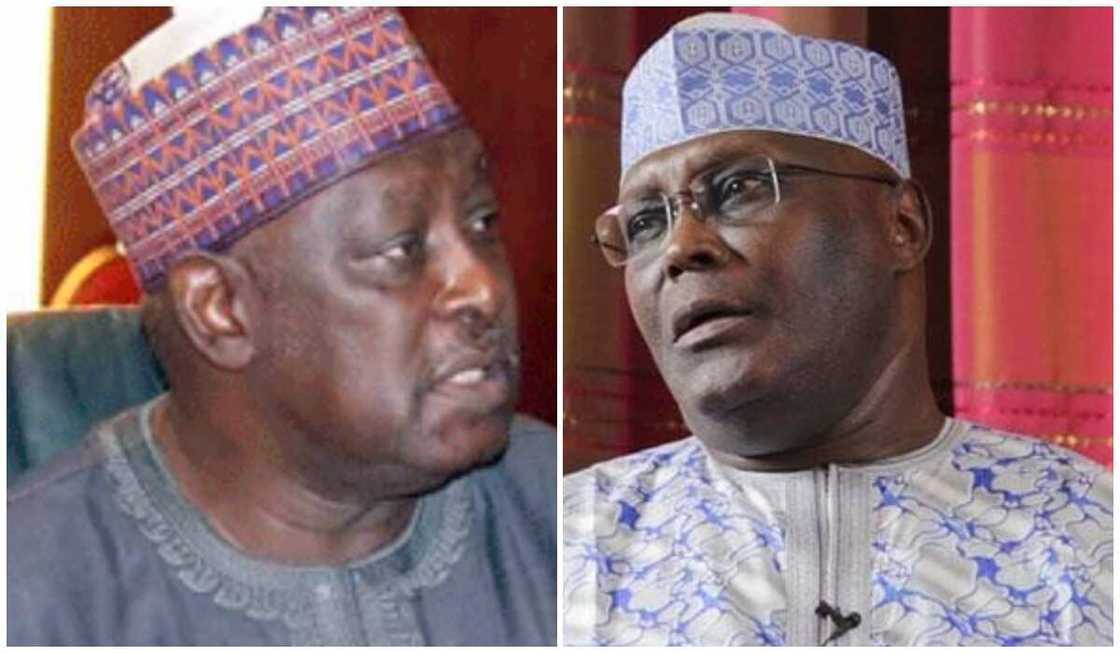
Former Vice President and African Democratic Congress presidential candidate, Atiku Abubakar, on Sunday condemned what he described as ethnic profiling and divisive rhetoric by former Secretary to the Government of the Federation, Babachir Lawal.
Atiku accused Lawal of stigmatising the Fulani ethnic group despite having accepted the highest public office under former President Muhammadu Buhari, himself a Fulani.
In a statement issued by his Senior Special Assistant on Public Communication, Phrank Shaibu, Atiku said Lawal’s recent attacks were “devoid of facts and evidence” and relied instead on “ethnic profiling and inflammatory rhetoric aimed at discrediting political opponents.”
“It was both dangerous and irresponsible to suggest that any Nigerian should be judged, condemned, or held accountable for crimes committed by individuals simply because they share a common ancestry,” Atiku said. He warned that such reasoning “threatens national cohesion and could further widen existing fault lines in a country already grappling with insecurity, economic hardship and political tensions.”
Atiku also questioned contradictions in Lawal’s public posture. “Nigerians are entitled to ask a simple question: which Babachir should they believe? The Babachir who claims to be a victim of political conspiracies and ethnic domination, or the Babachir who boasts that governors are scrambling for his services?” he queried.
The former vice president recalled that Lawal had served under Buhari without objection, accepting the privileges and prestige of the office. “It is therefore difficult to understand why he now seeks to stigmatise an entire ethnic group merely because another Fulani man seeks the presidency through democratic means,” Atiku said.
Highlighting his record of engagement with communities affected by violence, Atiku cited the attacks on Kagoro in Southern Kaduna. “When tragedy struck… I did not ask whether the victims were Christians or Muslims, northerners or southerners, Fulani or non-Fulani. Instead, I attended a church Thanksgiving service to identify with the grieving community, commiserate with families affected by the violence, and demonstrate solidarity with fellow Nigerians in their moment of pain,” he said.
On nation-building, Atiku pointed to his interventions following the abduction of the Chibok schoolgirls by Boko Haram. “Those young women are living proof that compassion is more powerful than bitterness and that nation-building requires action, not merely rhetoric. While some people chose to exploit national tragedies for political narratives, others chose to invest in healing and hope,” he said, citing scholarships facilitated at the American University of Nigeria, Yola.
Atiku concluded with a broad warning against ethnic stereotyping in political discourse: “Babachir may see tribe. I see Nigerians. Babachir may see division. I see a nation that must come together if it is to overcome its present challenges. That is the difference between politics driven by resentment and leadership driven by purpose.”
The exchange follows a Facebook post by Lawal, titled Kachalla II, in which he questioned Atiku’s character and competence and urged the ADC to replace him if they wanted any hope of winning the 2027 election.
Comments