


Beejay Sax Live At Indigo And The New Standard Of African Concert Production

 Quick Read
For years, the young troubadour has successfully captivated audiences with his ingenious melodic phrasing, choreographed performances, and witty improvisations. At Beejay Sax Live at Indigo, he continued his sojourn, endearing his fanbase with yet another sizzling experience that points to the expanding standard of concert production in the UK.
By Emmanuel Daraloye
At Beejay Sax’s recent live concert performance at Indigo, 02 arena, London, the air was shrill with a powerful tension as soon as the saxophonist climbed the stage. For years, the young troubadour has successfully captivated audiences with his ingenious melodic phrasing, choreographed performances, and witty improvisations. At Beejay Sax Live at Indigo, he continued his sojourn, endearing his fanbase with yet another sizzling experience that points to the expanding standard of concert production in the UK.
The show opened with a rousing introduction of the popular Yoruba gospel praise folk song, “Oyigiyigi”. It sets the tone for the entire medley which spans nearly half an hour, with several Yoruba gospel folk tunes in cue. Flanked by an entire ensemble comprising chords, percussion and backing vocalists, Beejay Sax kickstarted his performance with a flutter tonguing that felt anthemic and immersive at once. As lead melodic voice, he synced smoothly with the band, shifting from lead voice to supporting voice several times within the particular song. This fluid drift helped establish the most powerful anchor of his performance: resonance.
The performance continued with “Oyibiri biri kan mi o” and “E ba mi ra baba”, in which he elevates the traditional talking drum to complement his saxophone riffs in building a melodic call-and-response. At some point, Beejay Sax goes silent, letting the talking drum rain over the entire arena in building anticipation for his next set of notes. Interestingly, he switches into English-speaking songs with “You are God”, before going back to his line-up of Yoruba songs. The rest of the performance drifted with that same strong resonance that blurred the line between the vocals and melodies, uniting both as a single instrument.
Beyond Beejay Sax’s dexterity as a performer, what also stood out was the scale and control of the production around him. The performance did not only rely on his saxophone phrasing or stage presence; it also benefited from the careful orchestration of the live band, stage movement, sound balance and overall pacing of the concert. The concert maintained a level of cohesion that reflected strong production oversight.
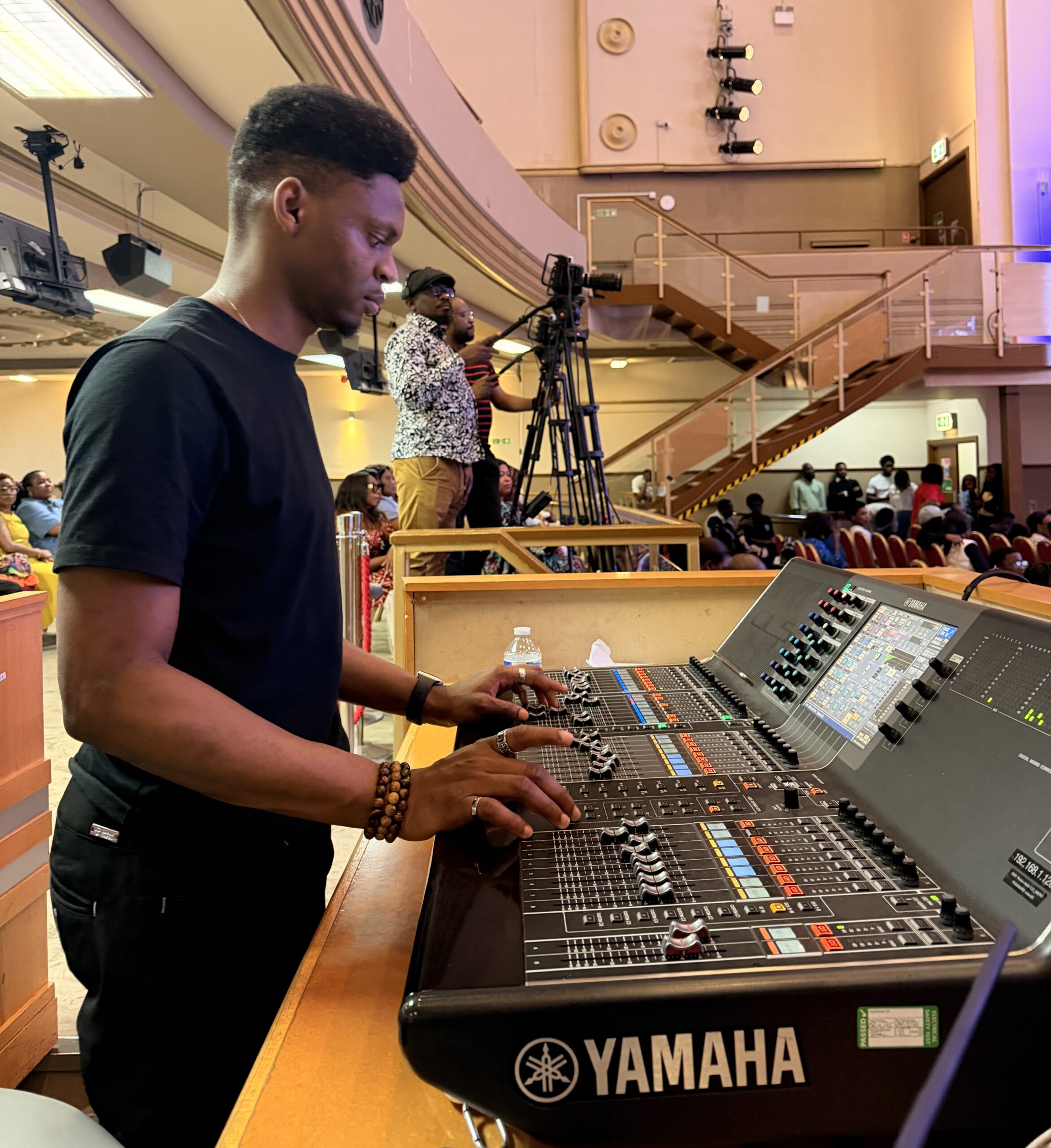
For the most part, a lot of African live music shows within the United Kingdom have been marked with a rise in professional execution. While maestros like Beejay Sax are at the forefront of this shift, there are also a handful of silent playmakers helping to stir this shift. One of such experts is Oluwaferanmi Julius Makinde, the brain behind the live concert production of Beejay Sax Live in Indigo. His expertise in handling such a large-scale live music production that brought together performance, stage coordination, live band arrangement, and technical audio execution within one of London’s recognised entertainment venues is nothing short of impressive.
Despite the scale of the venue, the room still held an intimacy that made the performance feel communal rather than a scattered gathering. Much of this intimacy came through the crowd work, especially in the call-and-response moments, intentional pauses, and the elevation of individual melodic interludes between the chords and percussion. Beejay Sax understood when to step back and allow the room to breathe, sometimes letting the percussion swell on its own, sometimes allowing the backing vocals carry the chant, before returning with a riff that pulled the entire arrangement back into focus. These moments helped shrink the large concert space into somewhat of a shared praise circle.
What also made the concert production effective was how smooth it felt overall, without getting too lost in its own melodies. For a performance built largely around medleys, riffs and extended praise sequences, there was a risk of the arrangement becoming too indulgent or repetitive. But the pacing remained distinct. Each tonal shift arrived with enough intention to keep the audience inside the moment, whether the band was driving towards a dance-heavy section or settling into a softer, more sombre groove. The transitions were relaxed and exciting but not loose or overwhelming.
Even with the crispness of the backing vocals, especially during the chants, the saxophone still maintained its place as the lead performing voice. Beejay Sax’s role as the director of that performance was still emphasized. At one point, he played a percussive staccato riff that sounded almost like a drum line beneath a scat-like chant of “Oya do like this, do like this, do like this,” to which the audience responded with dance. It was one of the clearest examples of his control as a performer. The saxophone kept steering movement, cueing energy, and shaping the audience’s response.
Ultimately, catharsis remained the show’s north star. From dancey praise tunes to more sombre passages, the tonal shifts were clear, relaxing and exciting in equal measure. The drums often rivalled Beejay Sax’s riffs, sometimes pushing against his melodies with their own force, but he still dominated the show by remaining the lead driver of each track. The occasional scat singing also added flashes of comic relief, loosening the musical tension and giving the audience room to laugh, dance and release. In those moments, the performance became more about emotional release, which seemed to be the true centre of the entire concert.
This is where Makinde’s contribution becomes even more important. His involvement formed part of the wider production backbone that allowed the performance to retain its sonic clarity and live balance throughout the night. In a show where the saxophone, drums, chords and backing vocals were constantly in communion, the production had to do more than amplify the sound. It needed to preserve the details within the arrangement while keeping the energy clean enough for each section to land with force. And it did just that.
Significantly, Beejay Sax Live at Indigo emerges as a rapid shift in the spread of African contemporary music culture in the UK. African-led concerts in London are increasingly carrying the scale and ambition of mainstream global live entertainment, while still retaining the communal pulse that makes African performance culture distinct.
Further, Makinde’s role was not limited to handling equipment from the background. His work directly influences live artistic delivery, where sound engineering directly shapes audience immersion and performer interaction on stage. At Indigo, the sound held together with enough precision to preserve the musical dynamics in real time.
As African live entertainment continues to gain stronger visibility across the UK, the production specialists working behind these events are becoming central to how African music is presented internationally. Makinde’s continued involvement in recognised live productions reflects this growing professionalism around the scene. In Beejay Sax Live at Indigo, that professionalism became revealed as part of the core ingredients that elevated the show to a standard of global repute.
Comments