


World Most Loved Countries 2026 : Nigeria, U.S., Russia drop drastically in global perception survey

 Quick Read
The survey suggests Americans generally view long-time allies more positively, while countries seen as geopolitical rivals or security threats receive lower ratings.
A new global survey has ranked countries based on how positively or negatively they are viewed around the world.
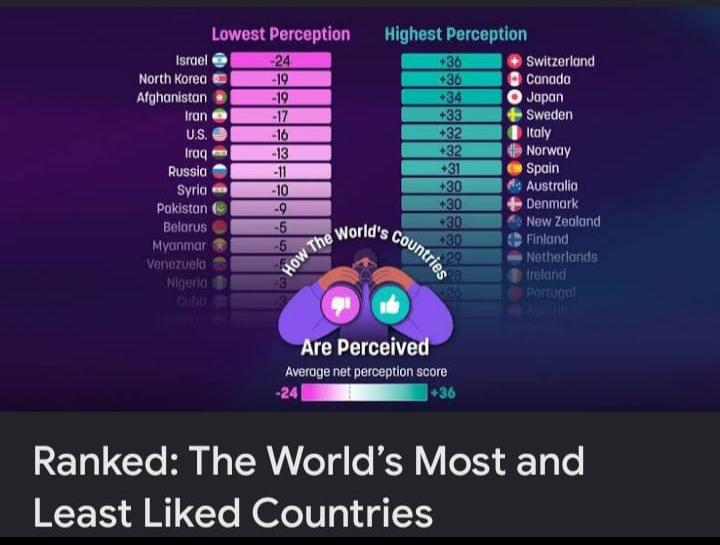
The ranking comes from the Democracy Perception Index 2026, which surveyed more than 46,000 people across 85 countries. The score for each country was calculated by subtracting negative opinions from positive opinions.
Most Positively Viewed Countries
Switzerland and Canada are the world’s most liked countries, each scoring +36. They are followed by Japan (+34) and Sweden (+33).
Top 20 countries by global perception:
Rank
Country
Score
1
Switzerland
+36
2
Canada
+36
3
Japan
+34
4
Sweden
+33
5
Italy
+32
6
Norway
+32
7
Spain
+31
8
Australia
+30
9
Denmark
+30
10
New Zealand
+30
11
Finland
+30
12
Netherlands
+29
13
Ireland
+28
14
Portugal
+26
15
Austria
+25
16
Greece
+24
17
Belgium
+24
18
Singapore
+21
19
South Korea
+21
20
Germany
+21
Many of the highest-ranked countries are in Europe. Experts suggest their positive image may be linked to political stability, quality of life, diplomacy, and open societies.
Declining Global View of the United States
The United States received a score of -16, placing it among the five worst-rated countries in the survey.
Although the U.S. remains one of the world’s most powerful nations, global opinion has declined over the past decade. Issues such as foreign policy decisions, political tensions, and trade disputes have contributed to a more negative perception.
The survey places the U.S. close to countries such as Iran (-17) and Iraq (-13) in terms of global perception.
Countries with Negative Perception Scores
Several countries received more negative than positive ratings, including:
Israel: -24
Afghanistan: -19
North Korea: -19
Iran: -17
United States: -16
Iraq: -13
Russia: -11
Pakistan: -9
Nigeria: -3
India: -2
Saudi Arabia: -1
Israel Ranked Lowest
Israel recorded the lowest score in the survey at -24. The country’s ongoing conflicts in Gaza and tensions involving Lebanon, Syria, and Iran have significantly affected its global image.
The survey shows that international opinion of Israel has become more negative in recent years, making it the lowest-ranked country among those evaluated.
How 45 Countries View the United States
Another survey examined how people in 45 countries view America.
Countries with the Most Positive Views of America
Israel and Nigeria ranked highest, with 83% of respondents expressing a favorable opinion of the United States.
Top countries with favorable views of America:
Country
Favorable
Israel
83%
Nigeria
83%
Morocco
68%
Vietnam
64%
Peru
64%
India
62%
Pakistan
61%
Philippines
61%
Argentina
58%
Colombia
57%
The findings show that support for the U.S. is often strongest in emerging economies and countries that see America as an important economic or security partner.
America’s Traditional Allies Becoming Less Supportive
Many Western allies, including Canada, France, Germany, and Sweden, reported lower favorability toward the United States than in previous years.
Trade disagreements, tensions over NATO, and other diplomatic issues have contributed to weaker perceptions among some of America’s longtime partners.
How Americans View Other Countries
A separate Gallup survey asked Americans how they view 21 major countries.
Most favorably viewed countries by Americans:
Japan – 85%
Italy – 84%
Canada – 80%
Denmark – 80%
France – 76%
United Kingdom – 76%
Germany – 75%
Least favorably viewed countries:
North Korea – 13%
Iran – 13%
Russia – 17%
Iraq – 21%
China – 34%
The survey suggests Americans generally view long-time allies more positively, while countries seen as geopolitical rivals or security threats receive lower ratings.
Key Takeaway
The 2026 surveys show that countries such as Switzerland, Canada, and Japan enjoy strong international reputations, while countries involved in conflicts or geopolitical tensions tend to receive lower ratings.
They also reveal growing differences between how countries are viewed globally and how they are viewed by Americans.
Comments