


Nigerian airlines dead on arrival — Allen Onyema

 Quick Read
Speaking during an interview on Tuesday, June 23, 2026, Onyema said the challenges confronting Nigerian airlines must be viewed against the backdrop of a global aviation crisis triggered by geopolitical tensions, particularly the ongoing conflict involving the United States, Israel and Iran.
By Nehru Odeh
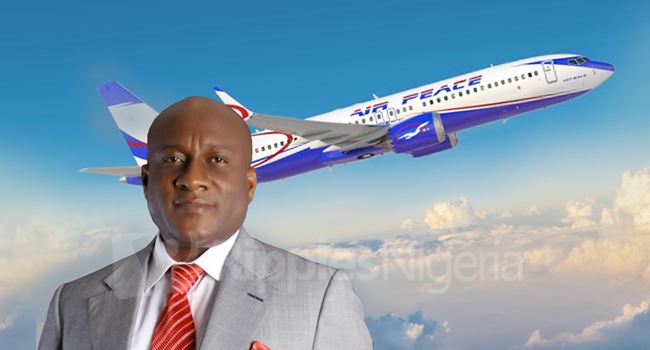
Mr. Allen Onyema, the Chief Executive Officer of Air Peace, has painted a grim picture of the state of Nigeria’s aviation industry, declaring that Nigerian airlines are effectively “dead on arrival” because of crippling operating costs, soaring fuel prices, multiple taxes and exorbitant interest rates on loans.
Speaking during an interview with Arise TV presenter Ojy Okpe on Tuesday, June 23, 2026, Onyema said the challenges confronting Nigerian airlines must be viewed against the backdrop of a global aviation crisis triggered by geopolitical tensions, particularly the ongoing conflict involving the United States, Israel and Iran.
According to him, the aviation industry worldwide has been struggling since the outbreak of the crisis, with airlines cutting flights and battling rising operational costs.
“What is happening to Nigerian aviation is global. It’s a global crisis in the aviation industry. It’s not just limited to Nigeria alone,” Onyema said.
“Since the advent of the US-Israel and Iran war, the aviation world has been adversely affected. You could see that airlines have been closing down, shutting down operations worldwide. Some legacy airlines, some of the biggest airlines in the world, are cutting up to 20,000 flights.”
He noted that while airlines abroad are struggling with aviation fuel increases of between 30 and 40 percent, Nigerian operators have had to contend with increases exceeding 250 percent.
“Many of them are struggling to survive. However, in my country, aviation fuel has gone beyond 250 percent. At a time it rose from about N900 per litre to about N3,300. You do the mathematics. This is what the Nigerian airline is supposed to grapple with.”
Despite these challenges, Onyema praised Nigerian airline operators for their resilience.
” You have to actually applaud the resilience of these Nigerian airlines who are just doing real patriotic services to their nation, yet unsung. No Nigerian airline is smiling now. We’ve all borrowed and borrowed billions just to buy fuel alone and fly.”
He explained that airlines now spend as much as N12 million to N13 million on fuel for flights that previously required about N3 million worth of fuel.
” You just fly for the fuel vendors. You take off to go to Abuja. Fuel used to cost about N3 million for a flight. Now it’s about N12 million, N13 million for the same flight. How many people are you carrying? The economies of scale don’t favour the Nigerian airline.”
The Air Peace boss contrasted Nigeria’s financing environment with that of developed countries, where airlines obtain loans at single-digit interest rates.
“These airlines from the Western world get their funding at 3 to 4 percent interest rate. Here in Nigeria, we get our funding at between 29 and 33 percent.”
Then came his most striking verdict on the industry’s condition.
“The Nigerian airline is actually dead on arrival,” Onyema declared.
“We have all cut down the number of flights we do in order to save costs.”
Onyema expressed admiration for industrialist Aliko Dangote and dismissed suggestions that the Dangote Refinery was responsible for the high cost of aviation fuel.
“I’m a huge fan of Aliko Dangote. We should look beyond the man and look at what that name represents to the average Nigerian and for our nation,” he said.
“Dangote’s fuel, through MRS, still remains the cheapest. But it’s the chain, the middlemen in between. Somebody buys from Dangote, sells to another person, and another person sells to another person before it gets to the airline. By then it becomes something else.”
He described the refinery as a strategic national asset that has helped cushion Nigeria from global fuel shocks.
“You can imagine what it could have been if there was no Dangote Refinery. In this time of the US-Iran crisis, this country would have been paying far more for fuel. The refinery has come to the rescue of this nation.”
Reacting to remarks by the International Air Transport Association (IATA) that Nigeria is one of the toughest places in the world to establish and operate an airline, Onyema said the assessment merely echoed what airline operators had been saying for decades.
“That comment wasn’t complimentary of anybody in this country. But we welcome it because over the years airlines in Nigeria have been crying to governments.”
According to him, aviation should be treated as a strategic national asset rather than a source of government revenue.
“Aviation is a catalyst of national strategic importance,” he said. “There is no UAE without Etihad and Emirates. Every country supports its airlines because they energise the economy.”
He lamented that more than 70 airlines have collapsed in Nigeria.
“Over 70 airlines have come and gone in this country. Nigeria has the highest mortality rate of airlines worldwide. That’s not complimentary.”
Onyema singled out the five-percent Ticket Sales Charge (TSC) imposed on airlines as one of the industry’s major burdens. “We refuse to accept it. If I charge N100,000, NCAA takes five percent. If I charge N200,000, NCAA takes five percent. I didn’t set up business with you.”
He urged President Bola Tinubu to establish an Aviation Taxes and Charges Review Committee.
“We want Mr. President to set up an aviation taxes and charges review committee. Let technocrats, government officials and airline operators sit down and review these charges that airlines have been crying about for years.”
Seeking Presidential Intervention
While acknowledging efforts by the Federal Government to improve the sector, Onyema insisted that urgent intervention was needed.
“We appreciate what this government has done for us, but they need to listen more to us and understand the pain points hitting these airlines.”
According to him, the collapse of airlines would have devastating consequences for the broader economy.
“If an airline goes down, banks will take a hit. Massive job losses will follow. We need to sit down with Mr. President and tell him face to face what is happening.”
Defending Air Peace
Onyema also defended Air Peace against criticism over recent flight disruptions, including complaints by actress Funke Akindele regarding passengers stranded at Gatwick Airport in London.
He maintained that the disruption resulted from a bird strike and stressed that safety remained non-negotiable.
“When it comes to safety, Air Peace takes no prisoners. No amount of intimidation or name-calling will make Air Peace take to the skies when we know it is one percent unsafe.”
He said affected passengers were accommodated at a five-star hotel and insisted the airline complied with international aviation standards.
“The hotel in question is a five-star hotel. The passengers were lodged there. Air Peace will never compromise safety.”
Onyema further lamented what he described as a tendency among some Nigerians to unfairly target local airlines while overlooking similar incidents involving foreign carriers.
“Once it’s a Nigerian airline, people start shouting. But when foreign airlines do the same thing, nobody says a word.”
As the aviation industry continues to navigate global turbulence and domestic economic pressures, Onyema urged government and stakeholders to rethink their approach to aviation.
“Airlines are not meant to be used to raise revenue directly for government. They stimulate tourism, economic integration and national development.”
For Onyema, the future of Nigerian aviation depends on urgent reforms, lower taxes, cheaper financing and greater government support.
“Time has come for government to listen. If those charges are not reviewed, airlines will continue to crumble in this country,” he warned.
Comments