



Peter Adeleke Unveils New PMP Exam Prep Book, Rolls Out Training for Professionals and CEOs

 Quick Read
According to Adeleke, project management has moved beyond spreadsheets, budgets and Gantt charts. He calls it the driving force behind successful organizations.
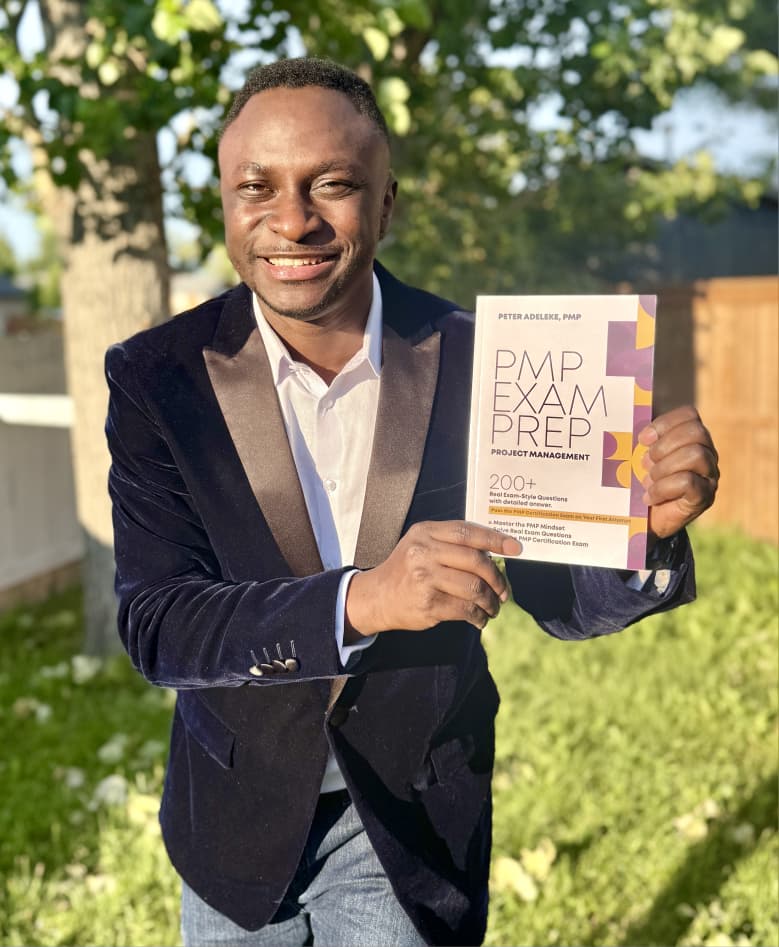
Project manager, leadership coach, author and Guinness World Record holder, Peter Adeleke, has unveiled a new project management book and scaled up his professional training program to support students, CEOs, business leaders, and working professionals preparing for the PMP certification.
The book, PMP EXAM PREP: Master the PMP Mindset, Solve Real Exam Questions, and Pass the PMP Certification Exam with Confidence, was published in July 2026 by Trailblazer Production. It marks Adeleke’s latest push to advance professional education and leadership development.
According to Adeleke, project management has moved beyond spreadsheets, budgets and Gantt charts. He calls it the driving force behind successful organizations.
“Every great vision is a destination, but project management is the vehicle that gets you there,” Adeleke said. “You can have a powerful idea, a brilliant team, and enough resources, but without structure, stakeholder engagement, risk management, and disciplined execution, a great vision will stay as just a beautiful drawing on paper.”
He said the new book was created to close the gap many professionals face — knowing project management theory but struggling to apply the right mindset to pass the PMP exam.
The expanded training initiative will provide practical project management knowledge and exam preparation strategies for aspiring project managers, students, executives, and professionals across industries.
Unlike traditional examination materials that can sometimes leave candidates buried beneath a mountain of definitions, formulas, and disconnected concepts, Adeleke’s new book focuses strongly on reasoning, professional judgment, and scenario-based decision-making.
At the centre of the book is the Peter Adeleke PMP Mindset Framework, a signature learning framework developed exclusively for the book to help candidates understand the reasoning patterns behind PMP examination questions.
Adeleke compares the framework to an operating system.
“A computer can have beautiful hardware, but without the right operating system, it cannot process instructions effectively. I see the PMP mindset in a similar way,” he explained. “You may know hundreds of project management terms, but if you do not understand how to assess a scenario, identify the project environment, engage stakeholders, empower the team, and select the best course of action, the examination can still become difficult.”
The Peter Adeleke PMP Mindset Framework distils essential project management principles and decision-making patterns into practical rules that candidates can apply across predictive, agile, and hybrid project environments.
Rather than encouraging candidates to memorize answers, the framework trains them to identify clues, understand the project environment, assess the situation, eliminate distracting options, and make decisions from the perspective of a proactive, value-driven project manager.
“I know how intimidating scenario-based questions can appear,” Adeleke said. “Sometimes, all four options look correct. The real challenge is understanding which answer is the best answer in that particular situation. I studied the logic, examined the patterns, and simplified the mindset. My goal is to help candidates stop hunting for memorized answers and start recognizing the reasoning behind the question.”
The new PMP Exam Prep book contains more than 200 realistic exam-style questions, detailed answer explanations, and practical case study scenarios designed to place readers inside real project environments.
The questions explore stakeholder engagement, servant leadership, emotional intelligence, team collaboration, conflict management, risk and issue management, change management, governance, business value, communication, escalation, and project delivery.
Readers are also introduced to predictive, agile, and hybrid approaches, with practical explanations of how to quickly identify the project environment presented in a PMP scenario.
The book addresses essential project management concepts, including organisational process assets, root cause analysis, lessons learned, the Requirements Traceability Matrix, Definition of Done, Minimum Viable Products, project life cycles, risk registers, issue logs, stakeholder engagement, and communication strategies.
According to Adeleke, the goal is not merely to tell readers that an answer is correct.
“If I tell you the answer is C, I may have helped you answer one question,” he said. “But if I show you why A is wrong, why B is tempting, what clue eliminates D, and what mindset makes C the best answer, I have taught you how to approach the next 50 questions. That is the difference between memorization and understanding.”
The book also features brand-new case study scenarios modelled around contemporary project management challenges. These scenarios are designed to strengthen analytical thinking and help candidates develop the professional judgment required to navigate uncertainty.
Beyond the publication of the book, Adeleke is also training aspiring project managers, students, professionals, business leaders, and CEOs through a structured PMP Exam Prep and project management training program.
The training combines live instruction, scenario analysis, question-solving sessions, project management concepts, exam preparation strategies, and Adeleke’s signature PMP Mindset Framework.
According to him, the vision is bigger than preparing people to sit for an examination.
“I want to train people to manage projects, lead people, engage stakeholders, solve problems, and deliver value,” Adeleke said. “The PMP examination is important, but the knowledge must not die at the examination centre. If you earn a certification but cannot navigate uncertainty, communicate with stakeholders, empower a team, or respond intelligently to change, then there is still a gap between the certificate and the competence.”
His training is designed for individuals preparing for the PMP examination as well as professionals seeking a deeper understanding of project management principles.
Business leaders and CEOs are also among the professionals Adeleke hopes to reach.
He argues that many business problems are, at their core, execution problems.
“A CEO may call it expansion. A founder may call it a new product. A community leader may call it an initiative. An educator may call it a program. But the moment you have an objective, a timeline, stakeholders, resources, uncertainty, and an expected outcome, you are already standing in the territory of project management,” Adeleke explained.
“Vision tells you where you want to go. Project management helps you build the bridge and cross the river.”
As organisations navigate technological change, global competition, evolving stakeholder expectations, and increasing business uncertainty, project management skills continue to play an important role in how organisations turn strategy into measurable outcomes.
The Project Management Professional certification is widely recognised as a professional credential in the project management field. For aspiring and experienced project managers, certification can demonstrate a commitment to structured project delivery, professional development, and internationally recognised project management practices.
Adeleke believes the value of PMP preparation extends beyond adding letters after a professional’s name.
“Certification can open a door, but competence determines what you do when you enter the room,” he said. “That is why my approach focuses on mindset. I want people to understand why a project manager assesses before acting, collaborates before escalating, empowers rather than micromanages, and continually focuses on delivering value.”
He added that project management education can also benefit professionals who do not currently hold the title of project manager.
According to Adeleke, entrepreneurs manage product launches, executives manage organisational transformations, educators manage programs, nonprofit leaders manage community initiatives, and professionals across multiple sectors are constantly responsible for temporary efforts designed to create specific outcomes.
“Many people are already managing projects without realizing that there is a professional body of knowledge, a structured mindset, and a set of tools that can make them better at what they do,” he said.
One of the personal sections of Adeleke’s new book is titled How PMP Changed My Mindset.
In the reflection, Adeleke discusses how studying project management strengthened his leadership philosophy and reshaped his approach to stakeholder relationships, collaboration, team empowerment, and problem-solving.
Already known for his work in leadership education, Adeleke said the project management journey deepened his appreciation for servant leadership.
“I have always believed in empowering people, but studying project management made me examine my leadership through another window,” he said. “I began to see areas where I could coach more, listen more, collaborate more, and allow people closest to the work to contribute to solutions.”
He describes the transformation as moving from always wanting to hold the steering wheel to understanding when a leader must trust the team to navigate.
“Leadership is not always about being the loudest voice in the room. Sometimes, the most effective project manager is the person asking the right question, removing an impediment, and creating an environment where the team can succeed.”
This leadership philosophy is woven throughout his new PMP book and training program.
Adeleke said one of the central motivations behind the book was his desire to simplify difficult concepts without reducing their professional value.
He compares the process to turning a complicated map into a working compass.
“Some candidates have read so much that they become more confused. They have collected information, but they still struggle to make decisions when they see a scenario,” he said.
“My book is a compass. I want you to read a question and begin to see the clues. Is this predictive, agile, or hybrid? Is this a risk or an issue? Should the project manager assess first? Should the team collaborate? Is a formal change required? Is this a stakeholder engagement problem? Once you begin to recognize the patterns, the fog starts to clear.”
The book includes a complete breakdown of the PMP examination structure, question approaches, time management strategies, and practical examination preparation guidance.
It also teaches candidates how to approach scenario-based questions and avoid common traps that can lead to incorrect answers.
“PMP is not a game of lucky guessing,” Adeleke said. “You must train your professional judgment. That is what I want to help people develop.”
With the release of his new book and the launch of his structured training program, Adeleke is inviting aspiring project managers, students, professionals, business executives, CEOs, and individuals preparing for the PMP examination to enrol in his project management and PMP Exam Prep training.
The training provides participants with structured learning, live project management instruction, scenario-based question analysis, practical case studies, PMP mindset training, and examination preparation support.
Adeleke said his goal is to build a community of professionals who can confidently move from ideas to execution.
“The world is full of brilliant ideas buried in the graveyard of poor execution,” he said. “I want to train people who can take a vision from the whiteboard to the real world. People who can lead teams, manage uncertainty, engage stakeholders, adapt to change, and deliver value.”
For candidates preparing for the PMP examination, Adeleke has a simple message:
“You do not have to walk into the examination overwhelmed by every question. Learn the mindset. Understand the logic. Train with scenarios. Practice the questions. I have studied the process and simplified it for you.”
Enrollment is now open for Peter Adeleke’s PMP Exam Prep and Project Management Training Program.
Aspiring project managers, business leaders, CEOs, students, and professionals interested in strengthening their project management skills or preparing for the PMP certification examination are encouraged to enrol and join the training.
Enrol in Peter Adeleke’s PMP Training Program and begin your journey toward becoming a more confident, strategic, and value-driven project professional.
The importance of the PMP certification extends far beyond passing an examination or adding three letters after your name. In a world where organisations are constantly navigating change, uncertainty, complex stakeholder expectations, and increasing pressure to deliver measurable results, project management has become the bridge between strategy and successful execution. A great vision without disciplined project management is like a powerful ship without a compass: it may have enormous potential, but it can easily lose direction. PMP preparation strengthens your ability to think strategically, lead diverse teams, manage risks, engage stakeholders, respond intelligently to change, and consistently focus on business value. Earning the PMP credential can demonstrate your commitment to professional growth and structured project delivery, but more importantly, developing the PMP mindset can transform the way you approach problems and make decisions. Certification may help open the door, but competence, judgment, and the ability to deliver value are what help you remain in the room and lead with confidence.
Comments