



When Hillary meets Jonathan

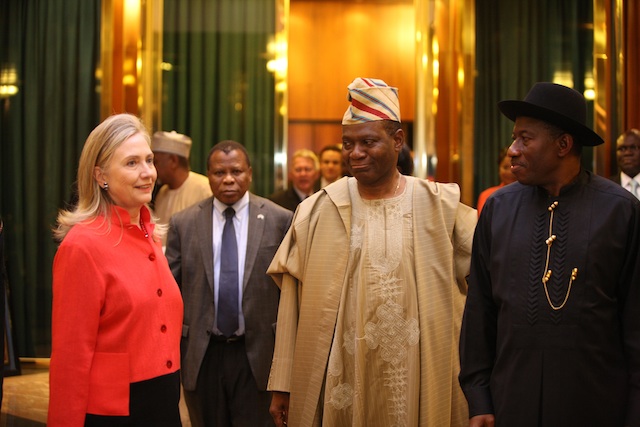
US Secretary of State Hillary Clinton met Nigeria’s president Thursday amidst increasing concerns about the Boko Haram insurgency and the helplessness of the Nigerian state.
Her visit to Nigeria, Africa’s most populous nation and a major supplier of US oil imports, comes with President Goodluck Jonathan under growing pressure to stop the violence in the northern and central regions of the country. The latest was the massacre Monday night of 20 members of Deeper Christian Life, who had gathered at a church in Okeke for Bible study.
Hillary Clinton urged the president of Nigeria on Thursday to push ahead with reforms as it faces the deadly Islamist insurgency which has shaken Nigeria.
Clinton said after meeting Jonathan, key ministers and security chiefs on the latest stop of her African tour that “we really believe that the future for Nigeria is limitless.
“But the most important task that you face, as you have said, is making sure that there are better opportunities for all Nigerians — north, south, east, west,” she said.
US diplomats have repeatedly spoken of the deep poverty in Nigeria’s north that many say has fed the insurgency.
“We want to work with you and we will be by your side as you make the reforms and take the tough decisions that are necessary,” Clinton added.
In his remarks, President Jonathan President Goodluck Jonathan commended the United States Government for its support in stabilising the Nigerian polity.
According to him, the Obama administration has been passionate and supportive of the Nigerian Government in the past three years.
“And of course President Obama’s administration is also quite passionate about Africa and Nigeria.
“He has always been very supportive of us in the past three years.
“From the days I came in as Vice President, especially that period as a nation when we faced a lot of challenges, when the late president was very ill and we passed through turbulent period.
“The support given to us is one that stabilised this country, and when we insisted we must conduct an election that is free and fair as the only way we can stabilise democracy, they were very supportive.”
He noted with delight that the support offered to INEC by the American Government had led to the conduct of an election adjudged by both local and international observers as the best election so far conducted in the country.
The president also commended the secretary of state for her support and assistance to Nigeria since she assumed office.
“Within this period of being secretary of state, she has raised the relationship between Nigeria and America to a very high level that we had never reached for quite some time.
“This, she did by personally chairing the bi-national commission and we have discussed various issues, security, economy and so on and so forth. She has been very, very supportive.
“So let me on behalf of the government and good people of Nigeria really thank you and President Obama and the good people of America for your support for Nigeria and Africa.
“I also want to thank you for all you are doing to make sure that this part of the globe develops.”
Overarching the talks is the insurgency by the Islamic Boko Haram sect, responsible for the death of more than 1,400 people since 2010, according to Human Rights Watch.
Clinton was to offer help to Nigeria in boosting the country’s investigative and intelligence capabilities.
“This is a problem for Nigeria, but also, northern Nigeria borders Cameroon, it borders Niger,” he said, expressing concern that a radical network could undermine the security of neighbouring states.
The US offer of assistance is to include helping to develop Nigeria’s forensics and investigative procedures, according to the official.
“We can help them develop mechanisms for tracking and determining individuals who are likely to be engaged in supporting Boko Haram actively,” the official said.
Washington would also be willing to help Nigeria develop an intelligence coordination centre that would assist the country in integrating information, the official said.
Some US lawmakers have been pushing President Barack Obama’s administration to label Boko Haram a terrorist group, but diplomats have resisted the designation, stressing it remains domestically focused.
In June, the United States labeled suspected Boko Haram leader Abubakar Shekau and two other Nigerian militants “global terrorists,” allowing any US assets they may have to be blocked.
Shekau appeared in a video posted to YouTube last weekend dismissing the designation and criticising Jonathan.
Nigeria has provided some eight percent of US oil imports, and crude production, based in the country’s south, has not been affected by the insurgency.
Boko Haram’s targets have continually widened, with the group having moved from assassinations to increasingly sophisticated bombings, including suicide attacks.
Members are believed to have sought training in northern Mali from Al-Qaeda in the Islamic Maghreb, Al-Qaeda’s north African branch, and Western nations have been monitoring closely for signs of further links.
Comments