


Showcasing Lagos State’s Agricultural Potentials

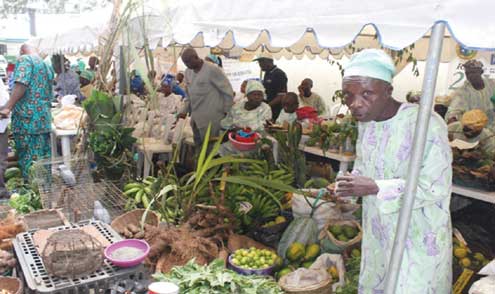
Lagos State flaunts its agricultural wealth
Last month, the world celebrated the World Food Day to mark the anniversary of the founding of the Food and Agricultural Organisation, FAO, in 1945 and draw attention to the need for countries to fully harness their agricultural potentials to feed the world’s ever-growing population.
In Nigeria, it was the perfect event for Lagos State to exploit to showcase its agricultural potentials through an Agricultural Show and Exhibition.
Different kinds of farm produce, brought by farmers from the various local governments in the state, were on display at the numerous exhibition stands. The produce included giant fishes, pigs, rams, goats, vegetables, dried fishes, yam, coconut, vegetable oil, palm oil and pawpaw. The exhibition provided proof that giant fishes do exist in Lagos seas. One of such fishes, locally called chinos, weighed 35kg. Another is the 32kg barracuda. The two giant fishes were caught from the river at Liverpool, in the Apapa local government area. As disclosed by Mr. Rahman Bashir, Head, Agriculture, Lagos State Ministry of Agriculture and Cooperatives, the Chinos was sold for N50,000, while the barracuda attracted N35,000.
Mrs. Dania Bolaji, a fish farmer at the Ikorodu Fish Farm Estate, posited that the fish industry in the state has lots of economic potential. “The government has done so much by opening the Fish Farm Estate and encouraging us to do well in fish farming. The government has also repaired roads so that we can move our produce to the markets easily. The industry is a growing one in Lagos. We have large turnovers in most months,” Bolaji enthused .
The poultry stand drew quite a crowd and attracted brisk business. Mr. Deji Fashola, a poultry farmer at the Aiyedoto Poultry Estate, Ojo local government, saw poultry farming in Lagos State as possessing lots of economic potentials with high market turnover. To him: “The poultry market is fast growing. Lagos State poultry farming has really improved and there is a bright future for the industry in the state. The Lagos State government is trying and lots of incentives have been given to poultry farmers. The state government has given our farm estate a 500KVA transformer to make the industry boom.” The challenge being faced by poultry farmers, Fashola said, was how to dispose the numerous waste generated by the birds, but noted that government had assured that it would provide equipment that would convert the waste to manure.
Mr. Samuel Alayode, a pig farmer at the Oke Aro Pig Farm Estate was of the view that farmers could harness so much revenue from piggery because it is lucrative. To him, piggery is the most profitable arm of animal husbandry. “The reproduction rate is high. The only challenge we face once in a while is epidemic outbreak, but this is a general problem,” Alayode stated.
Dr. Jimoh Olanrewaju, poultry consultant and farmer commended efforts by the Lagos State Governor to reposition agriculture, especially in three areas – poultry, fishery and rice production – where he, Olanrewaju believed, it has comparative advantage. “Lagos State used to be the leader in poultry production in the South-west and in the country but it has lost the position. But there are efforts by the current government to regain that position. In the fish industry, there are lots of farm estates around and the latest technology is being brought to make the industry viable.” However, he said, the efforts are not enough and will not guarantee or bring about food security because “beyond animal protein, we need to get arable land for farming and Lagos is not endowed with such.” The farmer tasked the nation’s leaders to introduce the innovations in global farming, like contract, computerised and highly mechanised farming, into Nigerian agriculture. “If nothing urgent is done, we will have problems as there will not be enough food to feed the growing population. We should go beyond rhetorics and implement strategies to enhance food security,” he advised.
But Special Adviser to the Governor on Rural Development, Babatunde Hunpe, assuring on food security, said the rural areas in the state are blessed with many agricultural potentials that could be properly harnessed to feed the Lagos populace. “We in the rural area represent the grassroots. We have poultry and pig farming at Ikosi and we have fish farming in Badagry where we breed fingerlings to empower our people. We are implementing the resolutions made at the last Lagos Economic Summit in the area of agriculture,” Hunpe stated.
Commissioner for Agriculture and Cooperatives, Prince Gbolahan Lawal added that efforts have been made to improve productivity in agriculture by focusing on the whole value chain, with emphasis on enterprises where the state has comparative advantage. Lawal said that the state’s concentration on agriculture aims at attaining food security and job creation. “Farmers have been linked effectively to markets and they have been creating job opportunities in poultry, agriculture, fisheries and horticulture in the state,” he quipped.
According to Governor Fashola, farmers and producers of agricultural products should take advantage of the various initiatives in the sector, as well as exploit the opportunities provided through cooperative societies for their personal and collective good. The governor said the government is striving to ensure food security in the state, stressing that the theme of the celebration, Agricultural Cooperatives: Key to Feeding the World was very relevant to the initiatives being adopted to address food shortages worldwide. Fashola added that the need to increase food production through cooperative activities could not be over-emphasised considering that there are an estimated 925 million hungry people in the world today. Ironically, 70 per cent of them are living in the rural areas where agriculture is the main source of survival and sustenance.
To expand its agricultural initiatives, the state government has gone to other states, such as Ogun, Oyo, Osun and Bauchi to acquire land for agricultural purposes. It expects to harvest farm produce before the end of the year from over 10,000 hectares of land cultivated in these other states to enhance its contributions to food security nationwide.
—KAZEEM UGBODAGA/TheNEWS magazine
Comments