


Secret Killings In Nigeria’s North

By Maduabuchi Nmeribeh
Terrorists, widely believed to be members of the dreaded Boko Haram Islamic sect, resort to clandestine killing of people, with their targets mostly southerners
In Northern Nigeria, human life is becoming increasingly worthless. Since 2009 when the dreaded Islamic sect, Boko Haram, embarked on an orgy of killings in some states in the region, its members have been snuffing out lives through bombing and shooting. By the middle of 2012, more than 5,000 people had been killed.
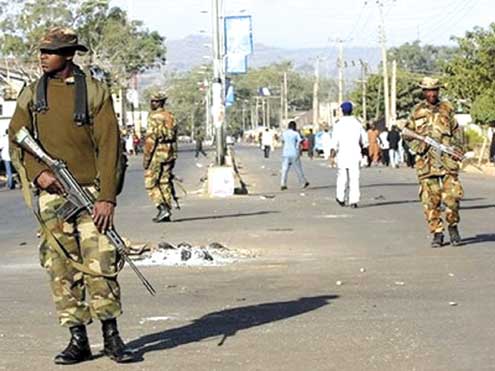
The spate of bombings has, however, been nipped as the Joint Task Force, JTF, the military outfit created by the federal government to combat terrorism, mount tough security apparatus in the region, especially in states where Boko Haram has been most deadly with its bombings. The region is now practically militarised, as the JTF not only mounts ubiquitous checkpoints, but has also been taking the fight to the sect’s members’ homes and hide-outs. The Force has been ferreting out the sect’s members, killing and arresting them and compelling many to flee the country.
The security cordon may have stemmed the bombings, but it has not deterred the Boko Haram members from carrying out their killings. Gradually deviating from the suicidal method of open bombing and shooting, which the JTF is rendering more difficult to achieve, the sect has resorted to clandestine killing of their targets. Its members are moving away from the cities into towns and villages where the long arm of the JTF can not largely reach. Over the past two months, the sect has, this way, eliminated many lives. Once in a while, its members sneak back into the cities to perpetrate their murderous activities. Since January last year, hundreds of people have been killed by gunmen in Kano. The killings appear to be increasingly assuming an ethnic coloration, as most of the victims were from southern Nigeria.
Two brothers, Nonso and Chisom Ejikeme, were such victims. From the proceeds she made from a kiosk where she sold snacks and soft drinks at a secondary school located in Hotoro Quarters, Kano, Mrs. Njideka Ejikeme, mother of the two boys, had seen them through secondary school after their father left Kano and reportedly disappeared. The intelligent boys secured admission into the University of Jos, with Chisom choosing to study Medicine and Nonso, the younger brother opting for Industrial Chemistry.
Chisom was in his third year and Nonso in second year when, on 21 November 2012, they decided to visit their mother from school. It was a journey to death, courtesy the Boko Haram killers. They were gruesomely murdered by the terrorists at the Hotoro Quarters in Kano State where she had lived for 20 years. Nonso had just finished helping the mother to prepare the evening meal, while Chisom was outside chatting with friends. As their mother narrated, tears streaming down her cheeks, Nonso went down to invite Chisom in for the dinner. “Minutes later, what I heard was a fussilade of gun shots. I called out to my children, but they didn’t answer. Fear gripped me. On rushing outside after the gunshots had stopped, I saw the bodies of my children on the floor, lifeless and with bullet wounds all over,” Mrs. Ejikeme sobbed. The boys were buried on 11 January 2013. Mrs. Ejikeme has since relocated to Nnewi, her home town.
About two weeks after the Hotoro incident, precisely on 6 December 2012, at about 7 p.m. Chukwuebuka Emmanuel Agazie, 15, and Daniel Nwachukwu, 17, were murdered by unknown gunmen at Anambra Line, Yankaba Quarters. Chukwuebuka, who hailed from Umuchu town in Aguata Local Government Area in Anambra State, was said to be a close, childhood friend of Daniel, a native of Emenyi in Owerri North Local Government Area, Imo State. Mr. Nwachukwu, Daniel’s father, told TheNEWS that on the fateful day, Daniel, who had just secured admission at the Imo State University, had visited Chukwuebuka. While Chukwuebuka was seeing off Daniel, just 200 metres away from his home, Chukwuebuka’s elder sister, who was in the bathroom, heard gun shots. She rushed out to the scene, to discover that her younger brother and his friend had been shot to death. An eyewitness said not less than 15 bullets were pumped into each of the two young men.
Within the same month, one Sunday morning in Naibawa quarters, gunmen on motorcyles ambushed and killed Evangelist Nkiruka Esther Emeh, her husband, Francis and their son. They have since been buried in their home-town, in Ngokpula Local Government Area, Imo State. “Two gunmen on a motorcycle opened fire on the car, killing the woman and her child on the spot while her husband died later in hospital,” Magaji Majia, spokesman of the Kano State Police Command confirmed. He said the couple’s other child escaped unhurt. Evangelist Emeh was a vocal voice at the Pentecostal Life Assembly on Abeokuta Road, Sabon Gari. Few days after the attack on the Emehs, on 17 November, gunmen on a motorcycle shot dead a lawmaker at a meeting spot in the same area. The tragedy was followed by that of another lawmaker, Isah Kademi, who was killed by gunmen at his guest house in Hotoro Quarters.
Also, during an explosion at the New Road Luxury Park on 26 January 2012, Mr. Humphrey Ogbonna nearly lost his life. Though he survived the attack, he was bed-ridden for over six months. Ogbonna, a patent medicine seller, who has returned to Kano after he has fully recovered, told this magazine that since the incident, life has not been rosy for him and his family, not only for the setback suffered by his business, but the huge amount of money he spent while receiving treatment.
Mrs. Hadiza Precious of Umuokpo Emeabiam in Owerri-West Local Government Area, Imo State, also lost her two children – Junior and Chimaobi – to the killers. They were shot in her presence. She has since left Kano and vowed never to return. Pastor Christian Nnamani Godson of Kings Family Bible Church and Chinedu Anthony Okeke, a young trader from Anambra State, also fell to the terrorists’ bullets. So did Peter Udofa from Ikono Local Government Area, Uyo, Akwa Ibom State. Udofa was murdered on 25 December while returning from the Christmas service.
On 16 September 2012, four gunmen suspected to be Boko Haram members went to Hotoro Quarters at 12.40 p.m. and wiped out the entire family of an officer of the Nigeria Security and Civil Defence Corps, NSCDC. Eyewitnesses said the insurgents killed the man, his four-year-old child and his physically-challenged younger brother. The gunmen beat the arrival of the JTF by about 30 minutes. A few days earlier, at the same spot, a young man described as an applicant had been killed in his father’s car in front of the residence of a member of the House of Representatives.
Young Matthew Akume from Benue State was killed at Dakata Quarters in the state capital. He was killed inside his business centre. Akume was shot at close range and some of his valuables, including his laptop, taken away by the suspects. “Four other persons were in the shop with him when they came. They asked two of them to lie down and the remaining two to go out of the shop, before they killed him,” said a witness. The late Akume was a renowned member of St. Louis Catholic Church, Bompai, Kano.
The tension and apprehension in Kano increased on Saturday 19 January when gunmen attacked the convoy of the Emir of Kano, Alhaji Ado Abdullahi Bayero. Though the emir survived, the gunmen killed six people. The Emir and his two wounded sons, Nasiru and Sanusi, heirs apparent to the Kano throne, were flown to the United Kingdom last Sunday for medical treatment.
On 22 January this year alone, no fewer than five people were killed by gunmen on a motorcycle at 6 p.m. in the Dakata axis of Kano. The incident occurred less than six hours after the state’s acting governor, Engr.Abdullahi Umar Ganduje in a state broadcast banned commercial motorcyclists following the attempted assassination of the emir. According to a resident who witnessed the Dakata killings, “I can confirm to you that gunmen on motorbikes opened fire on a group of people playing draft. I counted five dead bodies and several others were wounded.” Victims of the Dakata attack were Igbo and Yoruba.
President of the Ohanaeze Ndigbo in Kano, Chief Tobias Michael Idika, describing the killings as barbaric, maintained the Igbo are mostly targets of the attacks. “From 20 January 2012 when the Islamic Boko Haram sect unleashed their terror in Kano, the Igbo have lost more than 35 kinsmen with 25 were wounded. The manner we are being killed has forced us to conclude that we are the target of their terrorist attacks, because the victims we were talking about were properly identified by the terrorists before they were killed. Shockingly, no compensation was paid by the state government for all the 35 lives wasted from our community.
“We took our corpses home and buried them, and even bore the hospital expenses of the 25 wounded persons. There was, and is still fear and panic in Kano. Most of our people, mostly women and children had travelled back to the East. Things are no longer at ease in Kano. Our people, who are mostly traders are being gruesomely murdered at various locations in the state. Since November 2012, the killers have introduced another style of terrorist attacks on our people. Serial killers have taken over. In fact, within two weeks, at that time, Ndigbo lost 35 souls in Kano State; they were killed by gunmen on motorcycles. These co-ordinated attacks on various parts of the state where non-indigenes are living are consciously targeted at our people. The Ndigbo have remained endangered species in Kano and other northern parts of the state,” Idika moaned.
He accused Governor Musa Kwankwaso’s administration of insensitivity to the plight of the victims’ families. Idika said it was only recently that Mrs. Ejikeme, mother of the two killed brothers, told him that one Mr. Boniface Ibekwe gave her N400,000 at the burial of the two boys. She said the man told her Kwankwaso gave him the money to deliver to her. “This is all we know of the state government’s concern to our people,” Idika stated, while calling on President Goodluck Jonathan to declare a state of mmergency in parts of the North where the Boko Haram sect is slaughtering humans.
The Yoruba have also been counting their losses. Mrs. Victoria Dupe Ekundayo, 44, penultimate Tuesday lost Femi, her husband, to gunmen operating on a motorcycle at the Dakata area. Victoria, who has immediately relocated to the safe Sabon Gari area, was weeping uncontrollably when TheNEWS met her. “They have killed my dream, they have killed my joy. Femi never offended anyone. He is not a politician, he is not a trouble maker. What has he done that they killed him in such a brutal manner. Oh, what a wicked world! I have nobody in government, we are just ordinary Nigerians struggling to survive. Why did they decide to kill my husband in such a senseless and gruesome manner?” she cried
Fifty-four-year old Femi had elected to hang out with his neighbours and friends, while the evening meal was being prepared. It turned out to be a deathly decision. Some minutes after her husband left home, Victoria heard gunshots reverberating through their kitchen. “When I rushed out, behold! it was Femi’s lifeless body that assailed my sight.” Femi’s remains were taken to his hometown, Aiyeteju in Isanlu Local Government Area of Kogi State on Friday 25 January for burial.
Two weeks ago, Grace Tunji Ojeyinka, a mother of three, marked one year anniversary of her late husband, Tunji Ojeyinka who was shot by terrorists on 20 January 2012. Grace recalled that her husband was driving into Sabon Gari from Bompai on that fateful day when gunmen killed him. “He was inside the car with my children. According to my first son, the gunmen stopped the car and asked my husband to alight. They asked him some questions and then shot him immediately. They did not kill my children; the gunmen gave them N200 for their transportation home. My son said he saw a lot of other dead bodies. I have since then been struggling to take care of my children with this petty trading I do. We learnt that the Kano State government was compensating victims. We followed all the due processes for the compensation but up till today, the government has not given us any dime,” Mrs. Ojeyinka, who hails from Ikire in Osun State, told this magazine.
Prince Ajayi Memaiyetan, acting president of the Kogi State Community in Kano and foremost Yoruba leader, told TheNEWS that the terrorists were secretly killing Yoruba people in Kano. Memaiyetan revealed: “Secret killings are going on in Kawo, Dakata, Hotoro, Naibawa and Zaria Road. In many cases, their families silently claim the bodies from the morgue and take them home for burial. I know of one police officer from Igalaland in Kogi State, who was gruesomely murdered in his residence on Zaria Road recently.” He corroborated Idika’s allegation that the state government has not been widely compensating families of victims. Memaiyetan said he personally tracked Ojeyinka’s case to ensure Grace, his wife, was paid. “But one year after, his family was never compensated. I am aware that concerned institutions and individuals made generous donations to the families of these victims through the Kano State government. Yet, the administration refused to compensate most of them. It is a sad situation,” he regretted.
Dr. Jimpat Aiyelangbe, a Yoruba leader in Kano, agreed that there were killings but noted that it would be difficult to identify those who were killed, because, “when these things happen, you hear that somebody is dead, security agencies will remove the bodies and take them to the mortuary. So, it is somewhat difficult to say that so and so number of people have been killed.”
The killings are not restricted to Kano State. In Kaduna State, assassins have been paying their targets visits and killing them ruthlessly. This magazine learnt that the attackers identify targets they perceive as “enemies” and in some cases can wait for days, trailing him/her about until they deem it safe to strike.
At one point, the gunmen, it was learnt, marked police officers resident in the highly populated metropolitan Rigasa, Igabi local government area as their targets and began killing them in well-planned and calculated attacks. The then Kaduna State Police Commissioner, Mohammed Jinjiri had to order all police officers living within Rigasa to quit the area and move to the barracks for safety. It was after then that the frequent killing of police officers at Rigasa reduced.
But it has not stopped, as evident in the recent killing of two policemen on Friday 18 January 2013. The two police officers were manning a security check point at Murtala Crescent, Kawo New Extension on the way to Rafinguza, Kaduna, when assailants on a motorcycle opened fire on them and zoomed off immediately. TheNEWS gathered that out of 22 persons recorded killed within the last eight months in Kaduna State, 18 were police officers. The others were three Zaria-based medical doctors – Professor Hycinth Mbibu, a urologist at theAhmadu Bello University Teaching Hospital, Zaria; Dr. Chris Ugwu of Saidu Dange Hospital, Zaria and Dr. Andrew Abutu – and a traditional ruler, Malam Yahaya, Sarkin Arewa, Rigasa. Abubakar Mailemu, a Rigasa resident and close friend of the lateYahaya disclosed that the late traditional ruler was always criticising the Boko Haram insurgency, making him a target for elimination.
The Kaduna Police Public Relations Officer, Deputy Superintendent of Police Aminu Lawan, stated that the police in Kaduna State had declared war on the terrorists. Lawan mentioned that the new Police Commissioner of the state, Femi Adenaike, who was an officer from the Operations Unit, Abuja before he was recently deployed to Kaduna, has mapped out “proactive measures” to contain the incessant killings. Lawan said the police have been raiding many areas identified as the hideouts of the gunmen suspected to be responsible for the killings. On Monday 21 January, a team of police officers raided Danmaliki Street, off Nnamdi Azikwe Expressway and arrested 40 persons suspected to have been terrorising and killing members of the public. During the raid, items such as motorcycles, Indian hemp and masks were recovered.
The public seem not fully assured of the promises given by the police in the state to provide adequate security for the citizens. Residents walk about with caution and fear, despite the heavy presence of militarymen stationed on major roads and at flashpoints.
Borno and Yobe states have been the hottest killing fields for the Boko Haram sect. Boko Haram has maintained a reign of terror in both states, targeting churches, soldiers, policemen, government officials and traditional rulers. It is doubtful whether the total number of the killings in the two states can be captured appropriately: many cases go unreported and unrecorded. On Friday 28 December, gunmen suspected to belong to the Boko Haram sect attacked Musari village on the outskirts of Maiduguri metropolis, killing 15 villagers in their houses. According to a witness, the assailants tied the hands of their victims behind them before slitting their throats. No shot was fired so as not to attract the attention of the JTF and Police.
Musari village is located between the Baga Motor Park and the Maimalari Military Barracks on Baga road of the metropolis. A neighbour recalled: “We were asleep about 12.45 a.m. when we heard some people chanting Allahu Akbar and started knocking on the entrances of our houses. In one house, we heard, one of them ordered that ‘these two men be slaughtered’, while in the next, mother and child were crying and begging the assailants to spare their lives and that of the husband. But the three gunmen in that house shunned the pleas and killed two there by slitting their throats.
“It was in the same way the other 12 neighbours, including teenagers were killed, with the man who was apparently their leader shouting, ‘Tie their hands to the back and slit the throats of the infidels here.’”
Another witness narrated that he saw three Toyota Hilux patrol vehicles of the police at about 6.35 a.m. ferrying many bodies of villagers to the Specialist Hospital, Maiduguri, mortuary.
The JTF spokesman, Lt. Col Sagir Musa, said the gunmen sneaked into the Musari village community and secretly carried out their selective killings for three hours. He added that the Force arrested three suspected assailants and recovered one AK47 rifle with 10 rounds of 7.62mm ammunition.
In Yobe State, Boko Haram killers terminated the life of Paul Udeze, a 42-year-old businessman at Potiskum, four days after he returned to Yobe from the village to where he had taken his family to ensure their safety. Udeze, whose widow, Evangeline Ifeyinwa was five months pregnant with their fifth child when tragedy struck, was said to be the breadwinner of the large Udeze family and had many uncompleted projects, including the family house. The auto spare-parts dealer was said to be relaxing in his residence when the assailants barged in and shot him.
On the last Christmas Day Eve, suspected Boko Haram terrorists also invaded a church in Peri village, near Potiskum and killed the pastor and six worshippers. Members of the Evangelical Church of West Africa were holding their Christmas Eve service when the gunmen entered the village and barged into the church. They shot their victims and then set fire to the church. Agence France Presse, AFP, quoted Usman Mansir, a resident of the town, as confirming the killings. The development also confirmed security warnings that Boko Haram was planning to attack 10 states during the yuletide.
In November last year particularly, the Islamist militant group launched coordinated bombings and shooting attacks on the town. In one instance, on 10 November 2012, five Igbo residents of Gaidam were killed. The gunmen stormed the home of their victims and shot them, and even waited long enough to ensure they died before fleeing, as confirmed then by the state’s police commissioner, Patrick Egbuniwe. “The gunmen broke into the home of an Igbo iron welder and shot him dead. The attackers escaped and no one has been arrested for the attack,” Egbuniwe told AFP. Gaidam, which lies 135 kilometres (84 miles) from Damaturu, the Yobe state capital and near the border with Niger, is the hometown of the state governor, Ibrahim Gaidam.
In another, the Islamists, armed with Kalashnikov rifles, hurled explosives at the Gaidam police station, freed suspects, stole arms and raged through the town, burning six churches, a high court, a shopping complex and robbing a bank. Gunmen also killed three policemen and set ablaze three churches and a school in the town of Bonny Yadi in the volatile state, a military spokesman said.
Another killing in Potiskum was that of a seven-year-old girl shot dead during a failed attempt to kill her policeman father hours after the group’s members killed three others in a separate raid. The terrorists fired shots into the house of the police sergeant in the northeastern town. Police spokesman Toyin Gbadegesin said: “They fired shots at him while sitting in the midst of his family. He managed to avoid the bullets and scaled over the fence. The gunmen shot dead his seven-year-old daughter and seriously injured another 12-year-old daughter and a 10-year-old-son who are now in hospital.”
In another attack in Dikwa around 1.30 a.m, Boko Haram gunmen killed a policeman, a civilian and a local politician in co-ordinated attacks. The attackers burnt a police station, Freedom Hotel and a branch of Unity Bank. Those killed in the siege, which lasted for over an hour, included a former council boss, Alhaji Babagana Ali Karim. Their attempt to burn the Dikwa local government secretariat was repelled. The JTF Forward Operating bases in Dikwa and Gamboru, the 202 Battalion and the Nigeria Police personnel in the area were all called to action before the militants’ seige on the town could be smashed. Three sect members were killed by the military.
Musa said items recovered from the terrorists included an unregistered Isuzu pick-up van, a pump action gun, an AK47 rifle, a double barrel gun, a box loaded with assorted ammunition, 19 empty magazines of AK47 rifle, a bullet-proof jacket, a crash helmet and a DVD player. The JTF spokesman claimed that normalcy had returned to the area.
Attacks by the group and the security forces’ response to the insurgency are believed to have claimed more than 3,000 lives in Borno and Yobe states alone since 2009.
Every week, scores of Mercedes Benz 911 lorries leave the far North as people get more and more jittery about living in the North. When will the killings stop?
– Additional report FEMI ADI
.This article originally appeared in TheNEWS magazine of 04 February 2013
Comments