


When in Rome…

 Quick Read
Everyone must see Rome at least once, regardless of nationality, colour or creed. It is one of the few cities that connect all of the world in the same way Egypt does, with its history, its myths, legends and ancient ruins. We know of its most famous Generals and their conquests from the northern tip of Africa through Europe; Rome’s architecture as well as its fables and folklores are interwoven with those of many other places.
Wole Oguntokun
Everyone must see Rome at least once, regardless of nationality, colour or creed. It is one of the few cities that connect all of the world in the same way Egypt does, with its history, its myths, legends and ancient ruins. We know of its most famous Generals and their conquests from the northern tip of Africa through Europe; Rome’s architecture as well as its fables and folklores are interwoven with those of many other places.
The city does not need a dedicated building to show its artefacts off to visitors, the entirety being an open museum. Those who live there, say with wry smiles that they will never finish discovering the surprises of their beautiful home.
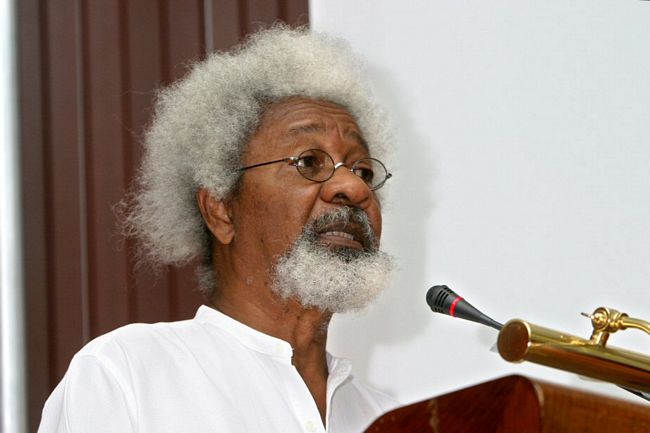
It was to Rome that the Nobel Laureate, Wole Soyinka, was invited to when he was to receive another highly prestigious award, this time from the 16th edition of the Europe Theatre Prize, a prize established in 1986 as a pilot project of the European Commission and recognised by the European Parliament and Council as a “European Cultural Interest Organisation”.
The Prize, this year, with events taking place from the 12th to 17th December, was made a part of the celebrations of the 60th anniversary of the Treaty of Rome and the G7 meetings, which coincided with 30 years of the Europe Prize and was specially promoted by the Minister of Culture and the President of the Italian Republic
I was given the honour of being the coordinator for Professor Soyinka’s interviews at “the prize” and I entered Rome a few hours after he did. That night after we met at the hotel we were put up in, WS, as many call him, and I, took a walk through the ancient streets of the city in search of a quiet café and some supper.
A few things became clear to me the instant I stepped out of the hotel with him – he is recognised everywhere around the world. As we walked through the streets, he turned away from restaurants that had the usual gaggle of tourists and looked for those that the locals themselves ate in.
However, even in the quietest side streets, I could see the eyes of people walking and those seated in outdoor cafes widen in recognition, and then the inclining of the heads and the quiet whispers with their companions would follow.
Strangers stopped us on the streets saying “I am a mathematician who was introduced to you in Barcelona” or “do you remember our conversation at that event in Germany?” He would answer gracefully each time although at times I wondered if he was just being nice, there were too many of them asking him to recall what at best were fleeting acquaintances.
His Italian was good enough to have us served the best food and I was grateful for that. There are few things as frustrating as being in another country and eating things you would rather not because you cannot order food aright.
On the morning of Friday December 16, we arrived at the Palazzo Venezia, the designated venue of my conversation with WS. There were hundreds of people from around the world in the packed hall and stragglers had to make do with standing. As he and I sat on the stage and I interviewed him about his life’s work, the audience listened in rapt attention; there were sighs and murmurs at his answers, an artistic journey that had spanned upwards of six decades. I had an epiphany during our conversation, a sudden realization that no matter how much we beat our chests and claim Wole Soyinka as ours, he belongs to the world, in many ways like the very city the ceremony was held in.
WS spoke with humour, with a sense of occasion and with conviction. He spoke of his description by “the Prize” as a bridge between Europe and the Arts in Africa and acknowledged that the Arts served as bridges that interconnected the world. He described Africa as having the best of both worlds, an appreciation of both foreign and indigenous art forms and that it was the loss of Europe and other places if they did not create room for African Art in their own events and cultural calendars.
The Palazzo Venezia where we sat, with its ornate ceilings and gilded trimmings,became a residential papal palace in 1469 and houses the National Museum. Benito Mussolini, Il Duceor the leader as he was then known, Italy’s President in the thirties and the years of the Second World War had his office there and used its balcony to deliver many of his notable speeches including the declaration of the Italian Empire in May 1936.
Wole Soyinka’s conversation met with a standing-ovation approval of the audience and the questions and comments afterwards came not only from the Italian audience but also from people who had travelled from Brazil, South Sudan, America and other places to be part of the event.
He was besieged in the National Museum area of the building after the conversation by radio interviewers and people who just wanted to take pictures while shaking hands, others who had been seeking an audience to give more awards, some who had profound things to say and others awestruck by the enigma that is WS and whom just wanted to stay in his presence, wordlessly.
I thought to myself, “Rock Star status doesn’t get to be bigger than this.” I, now also, understood his aversion to posing for photos apart from those he willingly takes with children. After a million flashes of the camera in your face, you might get slightly irritable too when uninvited cameras are pointed in your face.
We were saved from the crowd by Professor Soyinka’s Italian publisher and whisked into a taxi that drove us to a restaurant – the OsteriaRomana located in the vicinity of Campo de Fiori. The cuisine was traditionally Roman, and I, a philistine on matters concerning the high art of culinary matters, found myself rapidly learning about good food and wine. The restaurant had once hosted Bill Clinton, the American President, as they proudly let us know, but when they realised who was seated at a table, near-pandemonium ensued with the owners themselves, attending to us.
WS, his publisher and I, ordered our meals and the two began to discuss publications of his works. In the publisher’s possession were three beautifully bound Italian translations of “The Man Died”, “The Interpreters” and “Season of Anomy”. The publisher offered them as a gift to me and I discovered Professor Soyinka’s books had been translated and published in the Italian language for decades.
It was a working lunch for both of them but on my own part, I felt like the sinner who had somehow managed to find his way into heaven. He didn’t draw attention to himself; he just sat quietly and stayed. It was delightful to watch the Maestro and the equally savvy Publisher, rub minds, discuss past and future publications and gently thrust and parry. They knew each other well, it was apparent, and it almost didn’t seem like it was work being discussed.
At the end of lunch, the owners of the restaurant led us on a tour of the premises, and down a flight of stairs that led to “The Cave”. Here, we were surrounded by beautiful fragments of Roman history; a statue of Venus from the 2nd century BC, an original pre-Christian mosaic, a bust of the Emperor Nero…
On our way back to the hotel, I mused on how fortunate I was to be in this particular company and how it might influence the rest of my days as an artiste.
On the morning of the day of the presentation of the Europe Theatre Prize, WS and I took a taxi to the centre of town and then walked quite some distance to see more of the area. The long walk reminded me of the time in 2015 when I had been assistant director to him in the Nigerian premiere of his play, “The Beatification of Area Boy”. He would stand for four-hour stretches in rehearsals at Freedom Park, the former colonial prison on Lagos Island, then we would all take a one-hour break, after which he would return and stand ramrod straight for another three to four hours.
There is something the matter with our generation in this regard – I found not one of us, a fifty-strong cast and crew, ages ranging from twenty to fifty, could stand for up to half an hour without leaning against a wall, or looking for a chair or a tree stump to slump on, yet he did it effortlessly, day after day.
This clear-skied morning in Rome, we were headed in the direction of “The Spanish Steps”, a flight of steps on multi-levels leading to a very grand structure but he was not to tell me of the significance of “The Steps” until we arrived there.
As we stood on the crowded Spanish Steps, on a morning almost a day to the 31st anniversary of him becoming a Nobel Prize winner, he told me of how he had stopped by Rome on his way to Stockholm for that ceremony and how he had come to this place to reflect on receiving the world’s most prestigious award in Literature.
He had stood that day, years ago on the less-crowded steps, lost in his thoughts and then had walked a little distance,meeting one of the Romany, a gipsy woman carrying two children and begging for alms. He had given her a sizable amount of money, leaving her stunned as well as himself for he was not inclined ordinarily to giving beggars money, believing more that societies should look to creating environments that would not force the indignity of begging on its members.
Further on, he had come across a pavement artist; an intense, talented young man occupied by his own work. WS had stood for some time quietly among those who gatheredwatching the bearded young man, drawn to him, as one would be to a kindred spirit. He had felt an urge to help this man on his life-journey but was uncertain as to how the artist would react to unsolicited support. He then, had left the man to his work after a while and gone to look for a restaurant where he could be by himself and his thoughts and celebrate in peace.
However, that day, after he placed his food order, he could not get the image of the artist out of his head andhe got up, telling the restaurateurs he would be back shortly. When he found the pavement artist again, he had dipped a hand in his pocket and givenall the money he had, a fairly largesum, then turned, walking away quickly, not giving the younger man a chance to react.
When he looked back after some distance, he saw the younger man standing open-mouthed still, staring unbelievingly after the stranger who had become his benefactor and at the good fortune before him. Soon after, the artist gathered his belongings and left too, probably to reflect on time and chance and whatever pressing need might have been met in the nick of time by this stranger.
Thirty one years later, and almost to the day, WS stood at the same spot with another artiste who had followed him from Nigeria, and we went in search of the little restaurant where he had quietly celebrated that day, many years ago.
We found it.
When the owners of the restaurant discovered who he was and the significance of their restaurant to our outing that morning(I had made it my business to namedrop at them even though WS frowns at that kind of thing) they opened their premises to usdespite the fact that they had not resumed business officially that day.
As we had lunch, he spoke and laughed and taught and I knew things would never be the same with me.
That evening, at the Teatro Argentina, a truly magnificent opera house and theatre inaugurated in 1732, built over part of the curia section of the Theatre of Pompey, the same curia being the location of the assassination of Julius Caesar, Wole Soyinka made a different kind of history again, receiving yet another prestigious international award, the Europe Theatre Special Prize.
Wole Oguntokun is a playwright and theatre director based in Lagos, Nigeria.
Comments