



Building Collapse: When Compromise Breeds Needless Deaths, Loss, Agony

 Quick Read
Stating the contribution of substandard iron to the menace of collapsed buildings, Soji Adetokun, 35, an iron bender, revealed that sharp practices also exist in the quality of iron rods used for constructing supporting pillars and beams.
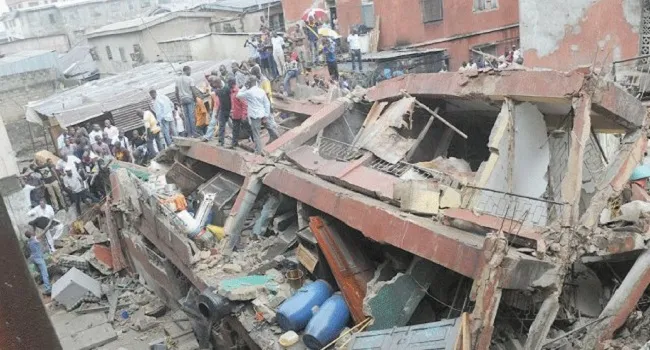
According to the 2018 emergency report of the Lagos Fire Service, a total of 11 buildings collapsed in the state in 2018, while 23 people died in the incidents. In 2017, the record of the Lagos State Emergency Management Agency also shows that 29 lives were lost in the 20 building collapse incidents recorded in the state. Thirty-four lives perished in the Lekki Garden City building collapse in 2016. Between January and June 2019, the state recorded seven incidents of building collapse, with the loss of over 24 lives, including pupils of Ohen Nursery and Primary School at Ita-Faji.

But successive governments have not watched the situation in helpless frustration. In the past, committees have been inaugurated and other measures taken, yet the structures would not stop crumbling. The death toll from the ugly incidents keeps rising, while many have, over time, sustained permanent disabilities.
The tragic incidents seem to be more peculiar in Lagos. To buttress the frequency of building collapses in the “Centre of Excellence,” a Tribunal on Collapsed Buildings set up by the former Governor of Lagos State, Babatunde Fashola, on November 18, 2013, reported that over 130 cases of collapsed buildings were recorded in the state between 2007 and 2013 alone.
The tribunal, in its report, said: “Over 130 cases of collapsed buildings were recorded in the state between 2007 and 2013 alone, while in 2014, no fewer than six cases were recorded by the Lagos State Building Control Agency (LASBCA). In these incidents, a total of 128 lives were lost, with the highest casualty figure of 116 persons coming from the Synagogue Church of All Nations Guest House incident that shook the world on September 12, 2014.”
Going by the tribunal’s report submitted to Fashola, an average of 18 houses collapsed per year, leaving hundreds of people bruised or buried alive. According to the Chairman of the tribunal, Architect Abimbola Ajayi, five buildings caved in while the panel was still sitting.
So prevalent are these incidents in the state that between January and December 2015, a total of 16 buildings collapsed.
Why Buildings Crumble
The causes of frequent building collapses are as numerous as structurally distressed buildings. According to the former Lagos State Commissioner for Physical Planning and Urban Development, Olutoyin Ayinde, a town planner, “Buildings won’t stop crumbling in Lagos until contractors stop the hasty development and embrace a scientific approach where all the appropriate and lawful steps in building are followed without compromise.”
The former commissioner said most Nigerians, including contractors, build by instalment and, as a result, jump due process when it comes to construction. He also said that Nigeria, particularly Lagos, continues to witness these unfortunate incidents due to the failure of builders who, according to him, either compromise standards for selfish reasons or are incompetent. He explained that building construction is scientific and requires due process by experts.
Ayinde, who is also the 2nd National Vice President of the Nigerian Institute of Town Planners, added that most builders hardly get approval before erecting their structures. Even when they do, they attempt to cut corners and flout building regulations.
“Building projects require serious planning. The ideal thing is that you must have the resources to fund the building from the acquisition of the land to the roof and virtually everything you need to do on the land. But the reverse is the case in Nigeria. People build piecemeal and without proper plans on how to fund construction. As a result, compromise sets in on the part of project handlers and property owners.
“There are other cases of collapsed buildings resulting from violations of approved building plans. For instance, there are instances where two floors were approved, and the consultant went ahead to build four storeys. There are also cases of professionals who are either inexperienced or compromising,” Ayinde added.
Investigations have also revealed that most buildings that circumvent official supervision are usually built at night and during other odd hours to avoid scrutiny by building regulatory and enforcement agents. This may be why the Lagos State government, at one point, prohibited building construction at night, on Sundays, and on public holidays to prevent structures from being erected when regulatory officials were not at work.
The directive, however, made little difference due to poor enforcement of the prohibition order.
Explaining the impact of substandard blocks on building collapses, the Chairman of Y.K. Block Industry, Alhaji Mustapha Yekini, identified the declining quality of cement and other building materials as one of the major causes of collapsed buildings. He said that most block makers are yet to adapt to the changing quality of cement mixtures in construction.
According to him, most block makers in Lagos use a bag of cement mixed with sand to mould 40 to 45 nine-inch blocks, while the standard—and in fact, the practice in other parts of the country—is a maximum of 27 blocks per bag of cement. “No matter how you look at it, substandard blocks can contribute to building collapse. The concrete beams in buildings rest on blocks. Some block makers could use a bag of cement to make even more than 45 blocks of nine inches, and it is usually 70 or more blocks if it is six inches.”
A chieftain of the Association of Real Estate Developers of Lagos State, Olumegbon Mutairu, was quick to blame the menace on the sharp practices of builders. According to him, “It is true that some of the major factors militating against the reduction of building collapses are greed on the part of some developers and the use of substandard or inadequate materials. You can’t expect the strength of a building constructed with a bag of cement for 20 blocks to be the same as one with 50 blocks per bag of cement.
“But on our part, we are collaborating with relevant state government agencies to check the menace of building collapses. We are sensitising our members regularly on standards and safety for human lives.”
An official of the Lagos State Material Testing Laboratory, who pleaded anonymity, gave a scientific dimension to the issue. Besides substandard building materials, he said, the salty nature of sand and water used by contractors in the state is another major factor. According to him, “Due to Lagos State’s location as a coastal area, most Lagos water is salty, just as the sand contains chemical reactions that may affect the mixture of the cement.
“The effect of all this shortens the lifespan of buildings, as some parts begin to chip off over time. The composition of salty sand and water also has a debilitating effect on the iron rods that form part of the concrete, causing the iron to rust.”
He also blamed the regulatory agencies responsible for monitoring and controlling the circulation of standard products. The continuous influx of substandard materials into the country, he said, shows that these agencies have no value for human life.
He said: “In other climes, fake or substandard materials have no place in the market; you can’t even find them. They shouldn’t be in the market in the first place if we had a working system in the country. If we are determined to prevent avoidable disasters, only the most qualitative building materials should be allowed in our market.”
Conflicting Interest Breeds Compromise
When price becomes the only deciding factor in the calculations of the building contractor and financier, compromise sets in. While the building owner wants to minimise costs as much as possible, the contractor wants to maximise profit, thereby pitting one interest against the other.
A developer who confided in this reporter said that the developer or contractor will always have his way since he dedicates his time and energy to the building more than the owner or financier.
New Telegraph also discovered that some builders often compromise, either due to the financiers’ inability to provide adequate funds for the project or for selfish reasons.
Another developer, who identified himself simply as Chief Ajasa, somehow justified the compromise. He said that for developers to maximise profit, they sometimes take loans from banks to assist landlords in constructing buildings, after which they collect rent for a certain number of years to recoup expenses incurred during construction.
“Since most landlords won’t let go of their land and lack the wherewithal to rehabilitate their distressed buildings, the only available option for them is to hand the buildings over to developers for rehabilitation or reconstruction, with a specific agreement on cost recovery,” he explained.
In such scenarios, according to Chief Ajasa, all expertise resides with the developer, who takes almost all the decisions, leaving room for compromises of all sorts. He told this reporter that he had built several houses under similar arrangements on Lagos Island and in the Ebute-Metta area of Lagos.
His words: “Some of these buildings are owned by aged landlords or deceased individuals whose children lack the ability to rebuild or renovate them. When we take possession of such houses with a view to rebuilding them, we make agreements with the family on the terms and conditions for recouping our money.
“So, in this kind of arrangement, there is no way the property owner will have a say on the quality of materials used. Hence, we opt for the cheapest possible materials. There is no way to make it in this business if one doesn’t know how because their conditions are usually difficult for us if we must adhere to proper building standards.”
According to him, there are times his colleagues have to reduce the number of cement bags used and cut down on iron rods, even when the property owner has the financial capacity to fund the renovation or construction work.
“For us to make a profit, there are instances where we use iron rods of lesser quality or those produced locally. Nothing will happen. That is how to survive in this job. And you know this is Lagos—before the building is completed, people will come and pay for two or three years’ rent. That is how we make our own money too. Na fish dey chop him fellow fish to survive in the water,” Chief Ajasa added.
Beyond the hunger for profit, there seems to be a psychological dimension to greed and corruption among Lagos developers, as many of them believe it is natural to cheat in order to survive.
A popular female developer on Lagos Island, who simply identified herself as Mrs Bose, said it is a taboo for a developer to handle the construction of two buildings without building another from the profits made.
“No building contractor should be unable to build an additional house from the contract of two buildings, no matter what. He or she must find a way around it. It is not corruption; it is simply knowing how to succeed in one’s field. If you call it corruption, what will you call those leaders who steal billions of Nigerian money with their pens?” she asked.
Substandard Materials and Their Consequences
Stating the contribution of substandard iron to the menace of collapsed buildings, Soji Adetokun, 35, an iron bender, revealed that sharp practices also exist in the quality of iron rods used for constructing supporting pillars and beams.
The artisan explained that if the iron steel is not strong enough, the building could collapse regardless of the quality or quantity of cement used in the construction.
Although he did not disclose whether he had ever used inferior materials for building construction, he confirmed that a typical Nigerian iron bender has the tendency to opt for inferior quality in order to make more profit.
His words: “No matter how much you give some artisans, for profit reasons, some will still buy substandard iron rods. But if the landlord or building owner pays enough, some might go for better quality. That is why if you are building, you must be ready to prioritise quality over your purse.”
The 1st Vice President of the Nigerian Institute of Building, Mr Kunle Awobodu, also listed faulty design, lack of comprehensive subsoil investigation, quackery, use of substandard materials, poor workmanship, non-adherence to professional advice, and greed as major reasons for the rising cases of building collapses in the country.
Awobodu, a former President of the Building Collapse Prevention Guild, also blamed the situation on weather conditions affecting building structures and other compounding factors.
Flouting of Building Regulations
According to the General Manager of the Lagos State Building Control Agency (LASBCA), Olalekan Shodehinde, the main reason for building collapses is the non-compliance of building owners with agency regulations and the influx of quackery in the construction sector.
He stated that people flagrantly flout building regulations and approvals, which is why, when buildings collapse—particularly storey buildings—investigations often reveal that builders had contravened approved guidelines.
“They don’t always build according to the approved plan, especially when it is a storey building. There are times when residential buildings are converted into six- or seven-storey shopping complexes by unscrupulous builders.”
“If you build properly and obtain government permits by following due process and engaging professionals, that building is not likely to collapse. If I could do magic to remove quackery from the construction sector, 50 percent of the risk would be solved,” he added.
He lamented that the entire construction process is being run by quacks in all cadres—engineers, architects, and town planners.
AREDOLS: Businessmen or Building Professionals?
While members of the Association of Real Estate Developers of Lagos State (AREDOLS), who are responsible for developing residential and commercial buildings, claim to be core professionals in the construction sector, experts disagree over their competency.
According to LASBCA boss Shodehinde, AREDOLS is a group of educated businessmen. While the group may have some professionals among them, they might not be registered professionals in the construction sector.
Weak Implementation and Corruption
Today in Lagos, several buildings have been marked and declared distressed, yet people still inhabit them. Some under construction and sealed for violating approved plans are allowed to continue construction, even when the conditions for unsealing them are unmet.
It is not uncommon to see building regulatory agencies aggressively marking buildings as distressed only when a building has recently collapsed.
Following the tragic collapse at Ita-Faji, the Lagos State Government said it demolished 40 structures that failed integrity tests out of 283 identified distressed buildings.
Giving details, the immediate past Commissioner for Physical Planning and Urban Development, Prince Rotimi Ogunleye, stated that 136 distressed buildings were identified in Lagos Island alone, while 60 weak structures were detected in Ikeja.
The Way Forward
Experts agree that failure to implement recommendations from previous investigative committees remains the root cause of recurrent building collapses.
It is ironic that after spending huge resources managing the aftermath of building collapse tragedies and setting up panels to investigate, committee reports rarely receive the necessary attention. Implementing recommendations remains the best way to prevent future occurrences.
Going by the findings of the six-member and five-member committees set up by Fashola and his successor, Mr Akinwunmi Ambode, on building collapses in Lagos, there is a need for stiffer penalties for anyone found culpable in the recorded cases of building collapse to minimise the incidences.
Both committees called for strict enforcement of the building law as well as the implementation of their recommendations.
For instance, the Building Collapse Tribunal set up by Mr Fashola and chaired by Mrs Abimbola Ajayi also called for the implementation of the provision of the law that empowers the state government to try violators and offenders of the building laws.
The Tribunal chairman said: “Although there is a provision for the summary trial of violators and offenders in the laws examined by the Tribunal, there is no record of any person prosecuted or sanctioned for incidents of building collapse by the Ministry of Justice, the Nigerian Police, or any other known organ.”
But with the continued trial and probing of the Synagogue Church building collapse by the Lagos State government, even with the change in government, experts are of the view that both building project financiers and contractors would think twice and prioritise the safety of human lives while erecting or rehabilitating any structure.
The experts, who also called on the government to probe other buildings that have collapsed after the Synagogue Church building tragedy, said that doing so would not only serve as a deterrent to others but also make people value lives and be more considerate while building. They advocate that such cases must be pursued to a logical conclusion to ensure that those found culpable in the building collapse case face the wrath of the law for their heinous crimes against humanity.
Comments