



Lagos targets N16.14tn Food Economy with Mega Infrastructure push

 Quick Read
The Lagos State Government has intensified efforts to transform agriculture into a multi-trillion-naira economic sector, unveiling major infrastructure and market reforms aimed at strengthening the state’s N16.14 trillion food economy.
The Lagos State Government has intensified efforts to transform agriculture into a multi-trillion-naira economic sector, unveiling major infrastructure and market reforms aimed at strengthening the state’s N16.14 trillion food economy.
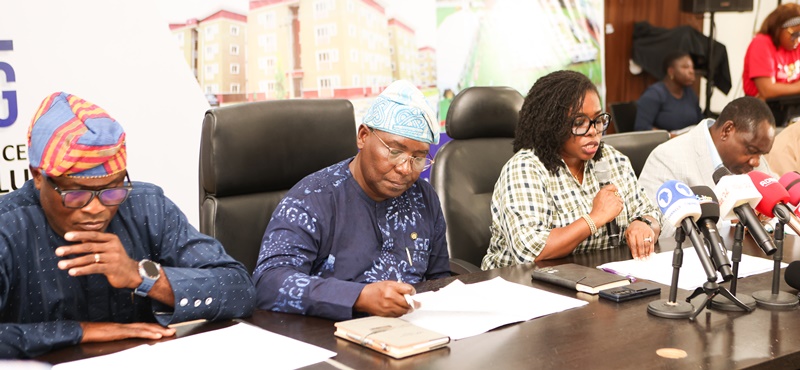
Speaking during the 2026 Ministerial Press Briefing held at the Bagauda Kaltho Press Centre in Alausa, on Friday, the Commissioner for Agriculture and Food Systems, Ms. Abisola Olusanya, said the state was shifting from isolated agricultural interventions to a coordinated food systems economy driven by infrastructure, logistics, technology and private-sector investment.
Olusanya said the government’s strategy goes beyond food production to include storage, transportation, processing, distribution and market access, with the aim of positioning Lagos as Africa’s leading food systems hub.
According to her, Lagos remains Nigeria’s largest food market, with an annual food economy estimated at N16.14 trillion, creating enormous opportunities for investors, farmers, logistics operators and agribusinesses.
She said one of the state’s flagship projects, the Lagos Central Food Systems and Logistics Hub in Epe, is expected to become the largest food logistics hub in Sub-Saharan Africa upon completion.
The commissioner disclosed that the facility is designed to handle over 1,500 trucks daily and support the storage, processing, aggregation and distribution of more than 1.5 million metric tonnes of food annually.
“The first phase of the Lagos Central Food Security Systems and Logistics Hub is scheduled for commissioning this year,” she said, adding that “This will mark a major turning point in Lagos State’s food systems transformation journey.”
Olusanya explained that the hub would feature cold and dry storage systems, processing centres, quality control laboratories, warehousing facilities, digital trading platforms and truck parks aimed at reducing post-harvest losses and stabilising food prices.
She added that the state had also launched the Produce for Lagos initiative and a N500 billion Offtake Guarantee Fund to support farmers, aggregators, logistics companies and investors by creating a structured market for agricultural produce.
According to her, the initiative is designed to tackle market uncertainty, improve food supply coordination and encourage investment in the agriculture value chain.
“The Offtake Guarantee Fund is designed to de-risk agricultural investment and build confidence among farmers, processors, logistics operators and financiers,” she said.
The commissioner noted that Lagos had continued expanding its agricultural infrastructure through projects such as the Imota Rice Mill, middle-level agro-produce hubs and the Lagos Aquaculture Centre of Excellence.
She revealed that the Imota Rice Mill, described as the largest in Africa and the third largest globally, produced more than 500,000 bags of Eko Rice within the year under review.
Olusanya further disclosed that the state had cultivated hundreds of hectares of rice fields across different locations to boost paddy production and support the rice mill’s operations.
On job creation, she said the government had trained thousands of youths, farmers and agribusiness operators through initiatives including the Lagos Agripreneurship Programme, the Lagos Agric Scholars Programme and the Lagos Agrinnovation Club.
She added that over 66,000 beneficiaries received support through various agricultural programmes between May 2025 and date.
The commissioner said the government was also seeking more private-sector participation in areas such as aquaculture, logistics, cold-chain systems, greenhouse farming, food retail, processing and digital agriculture.
“We are not implementing isolated agricultural projects,” Olusanya said. “We are building a complete food systems architecture that will strengthen food security, create jobs, attract investment and position Lagos as Nigeria’s food systems powerhouse.”
Comments