



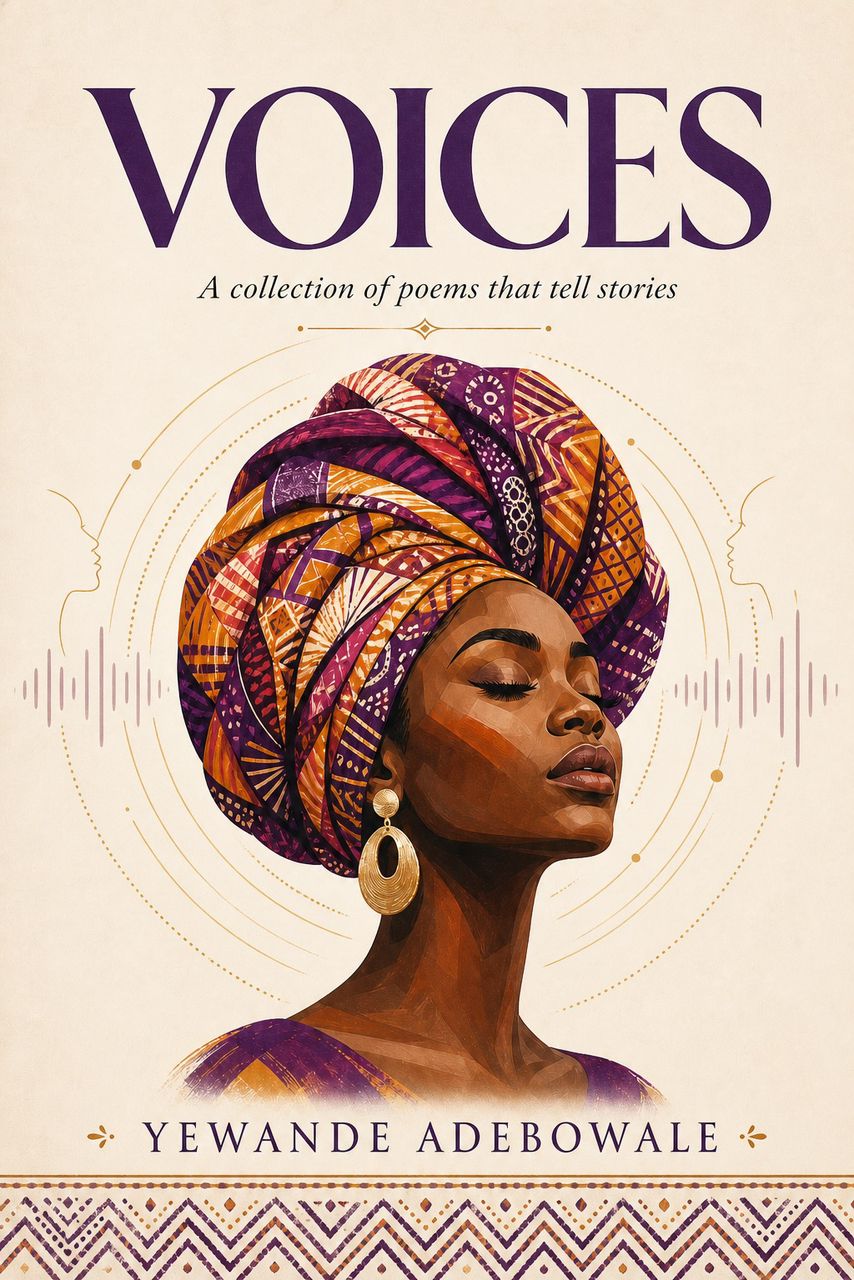
Voices: A Collection of Poems That Tell Stories – Where Memory Speaks in Full Sentences

 Quick Read
Yewande Adebowale’s 2016 collection Voices: A Collection of Poems That Tell Stories is not interested in poetry as ornament. It is interested in poetry as utterance, as recollection, as the place where feeling becomes legible.
By Sola Adesope
Yewande Adebowale’s 2016 collection Voices: A Collection of Poems That Tell Stories is not interested in poetry as ornament. It is interested in poetry as utterance, as recollection, as the place where feeling becomes legible. This is a book that turns toward speech, not away from it. Its poems do not hide behind mist or theatrical obscurity. They want to say something, and just as importantly, they want to be heard saying it.
What gives the collection its force is its trust in narrative. Adebowale does not treat a story as a burden the poem must escape. She treats it as material. In these poems, story is not a frame hung around lyric feeling. It is part of the engine. Things happen. People remember. Emotional truths unfold through event, aftermath, and tone. The poems understand that a life is not only made of images, but of episodes, consequences, and the language people use to survive them.
The title might suggest a chorus, and in a sense that is what the book offers. Not simply multiple speakers, but multiple textures of human presence. There are voices marked by intimacy, reflection, ache, and persistence. The collection listens closely to what experience sounds like once it enters language. It is attentive to the way memory speaks differently from grief, and the way endurance speaks differently from longing.
One of the more striking qualities of Voices is its resistance to decorative difficulty. There is no scramble here to seem inaccessible, no anxiety about being understood too quickly. That choice gives the book a quiet confidence. Adebowale writes as though clarity is not the enemy of seriousness, but one of its forms. The poems do not simplify feeling. They clarify it.
Seen now, nearly a decade after its publication, Voices: A Collection of Poems That Tell Stories feels like a case for poetry that remembers its oldest function. Before poems were puzzles, they were vessels. They carried story, witness, warning, praise. Adebowale’s collection works within that tradition, but without sounding old-fashioned. Its poems remain rooted in lived experience, in the friction between what is spoken and what is carried in silence.
That is why the book lingers. Not because it performs brilliance at every turn, but because it keeps faith with the human voice as a source of art, record, and emotional truth. In Voices, poetry is not trying to escape life. It is trying to speak it.
Comments