



A Tale of Being, Of Green and Of Ing: A Meditation on Existence and Continuance

 Quick Read
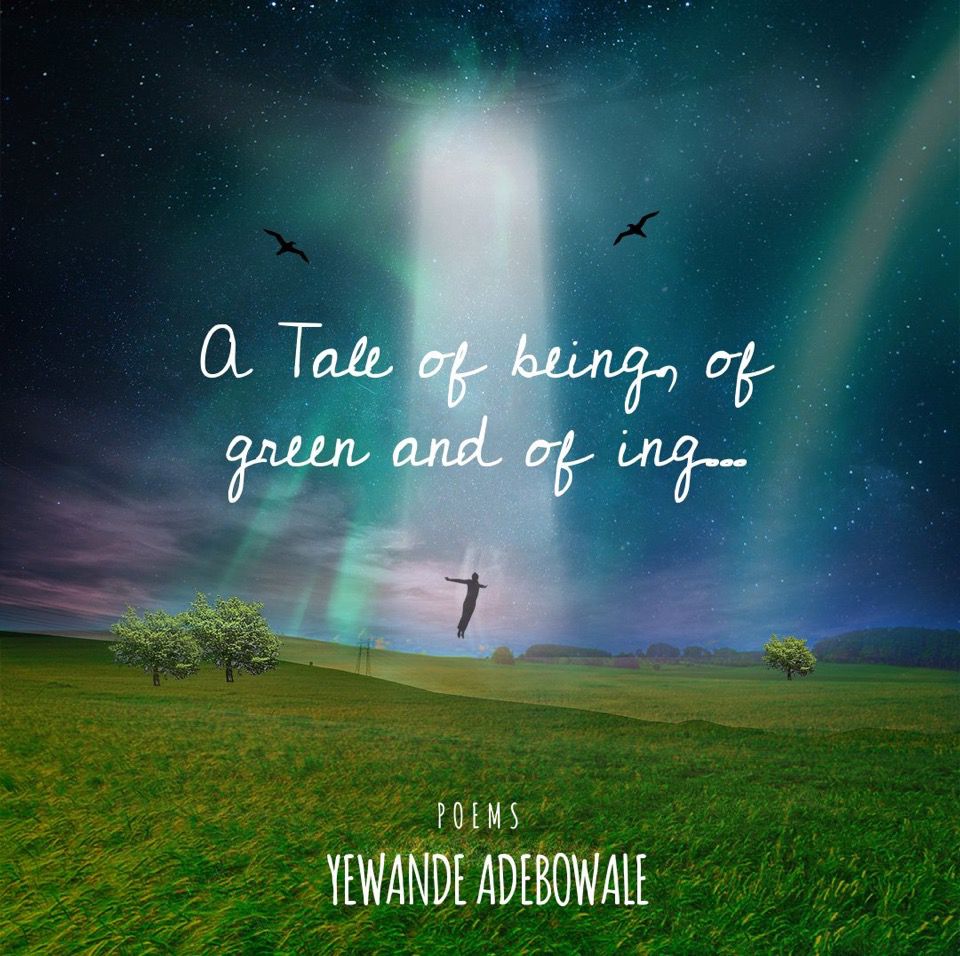
Yewande Adebowale’s “A Tale of Being, Of Green and Of Ing” is a poetry collection that invites slow and thoughtful reading. Composed in three parts, the book presents a reflective discourse on existence, growth, time, place and continuity. It is philosophical in outlook, but it remains grounded in lived experience, natural beauty and spiritual curiosity.
By Sola Adebowale
Yewande Adebowale’s “A Tale of Being, Of Green and Of Ing” is a poetry collection that invites slow and thoughtful reading. Composed in three parts, the book presents a reflective discourse on existence, growth, time, place and continuity. It is philosophical in outlook, but it remains grounded in lived experience, natural beauty and spiritual curiosity. Adebowale writes with an eye on both the visible world and the unseen forces that shape human understanding, creating a work that is meditative, searching and intellectually engaging.
At the heart of the collection is the concept of being. In the first part, Adebowale examines being as a beginning that knows no end, unfolding the idea through both physical and spiritual dimensions. These poems consider existence not as a fixed condition, but as an unfolding reality. The poet reflects on timelessness, transcendence and the possibility that what appears final may in fact belong to a larger cycle of continuance. This gives the work a philosophical texture that asks readers to pause and reconsider familiar assumptions about life, age and mortality. Age, in these poems, is not treated as a limit, but as a number within a wider and more enduring frame of existence.
The second part turns toward the experience of living in Nigeria, viewed through the eyes of an African negotiating the conditions of the present moment. Here, the book becomes more immediate and social without losing its reflective quality. Adebowale records the frustrations and joys of this experience with honesty and restraint. The poems attend to the contradictions of everyday life, where beauty and hardship exist side by side. In doing so, they offer a portrait that feels both personal and representative. Nigeria emerges not simply as a backdrop, but as a living reality that shapes thought, feeling and perspective. This section broadens the collection’s philosophical concerns by locating them within a particular time and place.
The third part of the book lingers on the earth, its beauty and its patterns. Here, Adebowale explores Mother Nature through an abstract discourse on succession, seasons, time and self-revolving forces. The green of the title finds its fullest expression in this section, where growth becomes both image and principle. Nature is presented not only as something beautiful to behold, but also as a system of meaning. Through cycles of renewal and recurrence, the poet reflects on the steady movement of life and the certainty of progression. The natural world becomes a language through which larger truths about continuance can be understood.
What makes “A Tale of Being, Of Green and Of Ing” distinctive is the coherence of its vision. Across all three parts, the collection insists on movement, growth and the certainty of becoming. The title itself suggests this motion. Being speaks to existence, green to vitality and renewal, and ing to process, continuation and forward movement. Together, they form the conceptual spine of the book.
Adebowale has written a collection that values reflection over spectacle and inquiry over conclusion. It is a book that asks readers to think deeply about existence, time and transformation. In that sense, it is both literary and philosophical, and certainly a work worth reading.
Comments