


PBAT Feeds targets 30,000 Lagos pupils in bold war against classroom hunger

 Quick Read
Speaking at a news conference, Adebowale said the initiative was conceived to address the growing challenge of hunger among schoolchildren, noting that many pupils arrive in classrooms eager to learn but are unable to perform at their best because of inadequate nutrition.
No fewer than 30,000 pupils in public primary schools across Lagos State are set to benefit daily from a new nutrition intervention designed to tackle classroom hunger and improve learning outcomes.
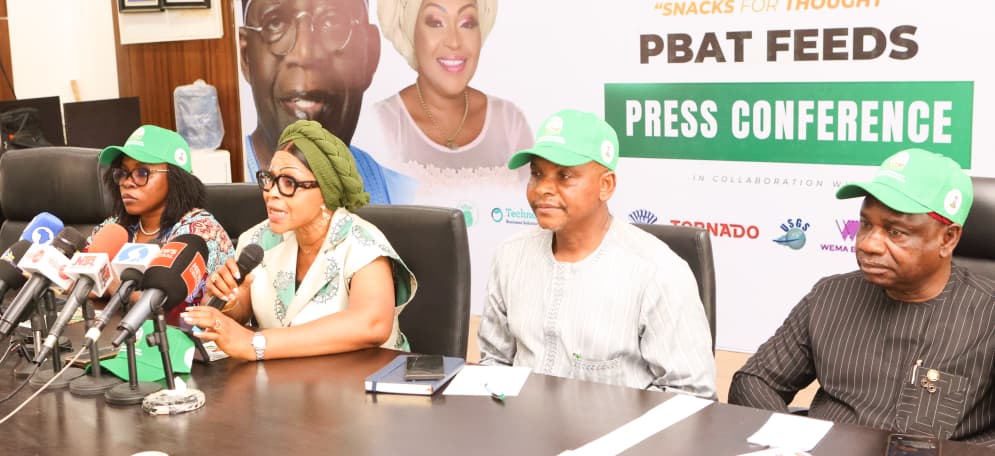
The initiative, tagged “Adopt A School for Snacks For Thought – PBAT FEEDS!”, was unveiled on Wednesday in Alausa, Ikeja, by the National Home-Grown School Feeding Programme (NHGSFP) Manager, Dr. Aderemi Adebowale, alongside a digital dashboard developed to enhance transparency, accountability and stakeholder participation in school nutrition support.
The pilot phase of the programme will run from June 30 to July 2, 2026, during which 30,000 pupils will receive nutritious snacks and beverages each school day.
Speaking at a news conference, Adebowale said the initiative was conceived to address the growing challenge of hunger among schoolchildren, noting that many pupils arrive in classrooms eager to learn but are unable to perform at their best because of inadequate nutrition.
According to her, research has consistently shown that hunger affects concentration, memory retention, cognitive development, classroom participation, school attendance and overall academic performance.
“A hungry child struggles to learn, and a child who struggles to learn is less likely to reach his or her full potential,” she said.
Adebowale explained that the initiative aligns with President Bola Ahmed Tinubu’s Renewed Hope Agenda, the objectives of the National Home-Grown School Feeding Programme and Nigeria’s broader human capital development goals.
“Our vision is to build a Nigeria where no child is prevented from learning because of hunger. Nutrition is not merely a welfare intervention; it is an investment in human capital development and national productivity,” she said.
Under the adoption model, individuals, corporate organisations, foundations, development partners, alumni associations, faith-based organisations, professional bodies, community groups, as well as state and local governments, can support the provision of nutritious snacks and beverages for schoolchildren.
Sponsors can choose to adopt a classroom, a grade level, a school, multiple schools, a local government area, a senatorial district or even an entire state.
According to Adebowale, the initiative is designed to democratise giving and provide a simple platform through which Nigerians can directly contribute to the educational and nutritional wellbeing of children.
A major highlight of the programme is the introduction of the Adopt A School for Snacks 4 Thought Dashboard, a first-of-its-kind digital platform that will serve as the operational, monitoring and accountability engine of the initiative.
The dashboard allows sponsors to search for schools by state, local government area or senatorial district, access school profiles and enrolment figures, and complete sponsorship commitments online.
It will also provide real-time information on adopted schools, schools awaiting sponsorship, the number of beneficiaries reached, geographic distribution of support and sponsorship status.
“This dashboard is a game changer. It moves school support from a traditional donation model to a measurable impact model. Sponsors can see exactly who they are helping, where support is going, how resources are being utilised and what outcomes are being achieved,” Adebowale said.
She added that the platform incorporates live monitoring and verification tools, including attendance tracking, distribution verification, geospatial mapping, impact monitoring and field validation mechanisms.
The dashboard’s analytics, she noted, will also help government agencies and development partners identify underserved schools, target vulnerable communities, strengthen resource allocation and improve policy decisions.
Adebowale expressed confidence that the initiative would contribute to improved school attendance, better classroom concentration, enhanced learning outcomes, reduced short-term hunger, stronger community participation and increased corporate social responsibility.
She called on stakeholders across the country to support the programme, describing it as a collective investment in Nigeria’s future.
“Every child deserves the opportunity to learn. Every classroom deserves the opportunity to thrive. Every community deserves the opportunity to participate in shaping the future.
“By adopting a school, supporting a child or partnering through the PBAT FEEDS Dashboard, stakeholders become active participants in building a healthier, smarter and more prosperous Nigeria,” she said.
Comments