



GO HARD or Go Home? Tayblet’s Early EP Shows Promise

 Quick Read
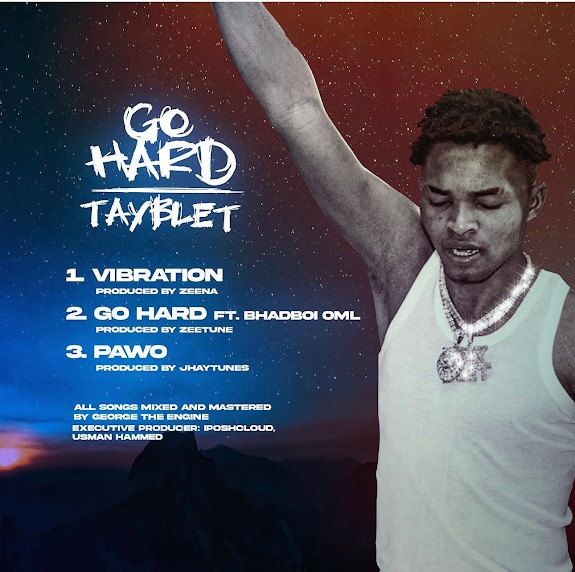
Tayblet already has several things many emerging artists spend years trying to find: a natural vocal presence, cultural grounding, and a clear sense of the musical space he wants to occupy. GO HARD, the three-track EP, sits between Afrobeats, street-pop and Yoruba musical influence, built around ambition, money and belief.
Emmanuel Daraloye
Tayblet already has several things many emerging artists spend years trying to find: a natural vocal presence, cultural grounding, and a clear sense of the musical space he wants to occupy. GO HARD, the three-track EP, sits between Afrobeats, street-pop and Yoruba musical influence, built around ambition, money and belief.
GO HARD is built around a familiar instruction: work, endure, and wait for the reward. It is a message that has powered countless Afrobeats and street-pop records. What gives Tayblet’s third EP some distinction is not the ambition itself, but the Yoruba language and cultural memory he uses to make it feel personal.
“Vibration” is the clearest example. Zeena’s guitar-led production has a relaxed, open feel, with panned guitar lines that give the song a sense of ease. Tayblet’s reference to Yemoja, “Pretty mother of the sea, let a fine boy win today,” gives the track a detail that cannot be separated from his cultural world. It is playful, spiritual, and self-aware at once. The problem is that the song does not build enough around that idea. After opening such a vivid door, it returns to more general talk of winning and celebration.
The title track is more straightforward. Zeetune keeps the chords restrained, allowing the drums to do the heavy lifting while Tayblet lays out his belief in hard work. The production is effective because it does not crowd the message. Yet the writing is also where the EP becomes most familiar. The determination is clear, but the song needs more personal detail to separate it from many other hustle anthems.
Bhadboi OML changes the temperature of the record. His Yoruba street delivery has sharper edges, and the King Wasiu Ayinde reference, “E ba mi pa lase,” gives the song a cultural weight that Tayblet’s own verse does not always match. The feature is valuable because it does more than add a name. It reveals the kind of specificity the title track needs more of.
“Pawo,” produced by Jhaytunes, is the EP’s strongest sonic decision. It borrows Amapiano log drums and rolls but keeps them inside an Afrobeats groove. The result is less obvious than a full Amapiano pivot and more useful for Tayblet’s sound. The track moves, but it does not lose its centre. Its weakness is thematic repetition. By the final song, the EP has returned to money and progress without opening a fresh emotional angle.
Tayblet’s delivery holds the project together. He has a relaxed confidence, and he moves between English, Yoruba and street language without sounding like he is performing an identity borrowed from elsewhere. The ease is real. But ease alone cannot carry a full project forever. The next step is not more production tricks. It is more of the cultural and personal detail that makes “Vibration” and Bhadboi OML’s verse on “Go Hard” stand out.
GO HARD is a useful early marker. Its best moments show that Tayblet’s strongest route is not generic hustle music, but ambition filtered through Yoruba language, memory and rhythm.
Comments